

There’s a warehouse somewhere in the Midwest. It’s climate-controlled. Storage racks run thirty feet high, floor to ceiling, loaded almost entirely with sneakers. Every brand. Every era. Tens of thousands of pairs, collected methodically over decades by a kid from outside Chicago who decided early on that sneakers were the clearest lens he had for understanding design, culture, and the world.
That warehouse belongs to the Virgil Abloh Archive. And right now, for the first time since Virgil died in November 2021, something is coming out of it.
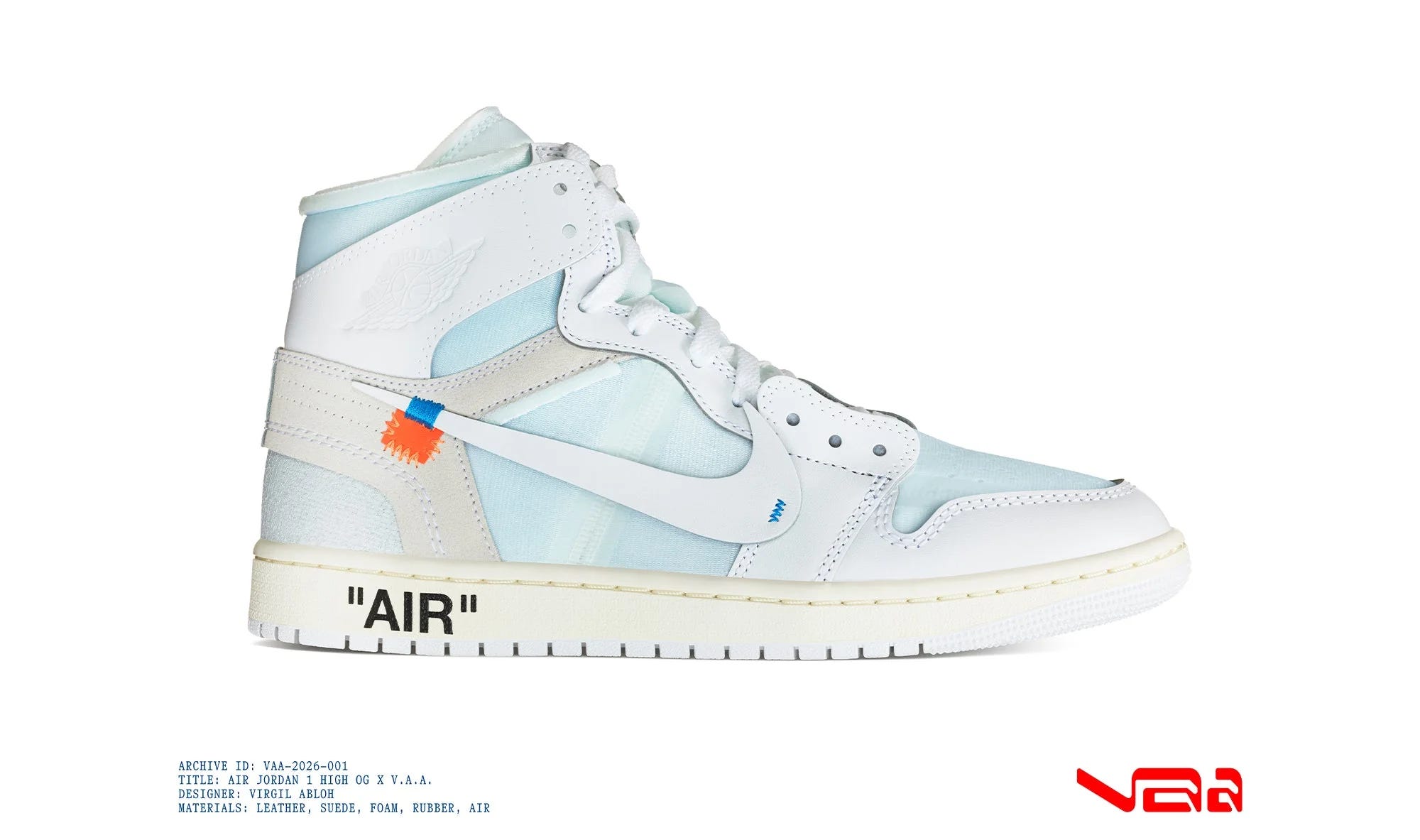
The Air Jordan 1 High OG x V.A.A. “Alaska” is the first global product drawn from that collection. The all-white deconstructed Jordan 1 that served as the foundation object for everything that became The Ten. Priced at $230. Launched through a series of World’s Fair activations in Los Angeles, Chicago, New York, London, Paris, Hong Kong, and Tokyo, complete with artist talks, workshops, screenings, and exhibitions built around Virgil’s creative practice. Stewarded by Shannon Abloh and co-directed by Mahfuz Sultan, who sat down with Complex earlier this month to explain, in detail, why this shoe and why now.
Meanwhile, about three weeks ago, someone spotted Off-White hoodies in a Costco Canada warehouse. Black, white, and royal blue. One hundred percent French Terry. The Off-White logo across the front, the outlined X sprawling across the back. Sixty-two Canadian dollars. Roughly $45 USD.
Both of these things happened in March 2026. Both of them carry Virgil Abloh’s name, at least in the cultural imagination. And they could not be more different.
To me, that contrast tells you everything about what happens to a creative legacy when it gets separated from the people who actually understood it.
How We Got Here
I need to back up, because the ownership chain of Off-White is genuinely one of the more complicated corporate stories in recent fashion history. And I’ll be honest with you... somehow, I have a personal stake in understanding it.
It started with a consulting engagement. Stadium Goods brought me on to help them build out marketing and communications to their consignor community... the collectors and resellers who were the actual lifeblood of the business. It was interesting work, and the people there were genuinely incredible. After about eighteen months, they convinced me to come on full-time. The compensation package was heavily loaded with Farfetch stock.
You can probably see where this is going.
The same Farfetch that had acquired Stadium Goods itself for $250 million in 2018... part cash, part Farfetch stock... and then, in August 2019, acquired New Guards Group... the Milan-based company that operated Off-White as a licensee... for another $675 million. Twice New Guards’ annual revenue. Seven times its earnings. Farfetch’s stock dropped forty percent in after-hours trading the day the New Guards deal was announced. Which, in retrospect, was the market telling us something it would keep telling us until nobody could ignore it anymore.
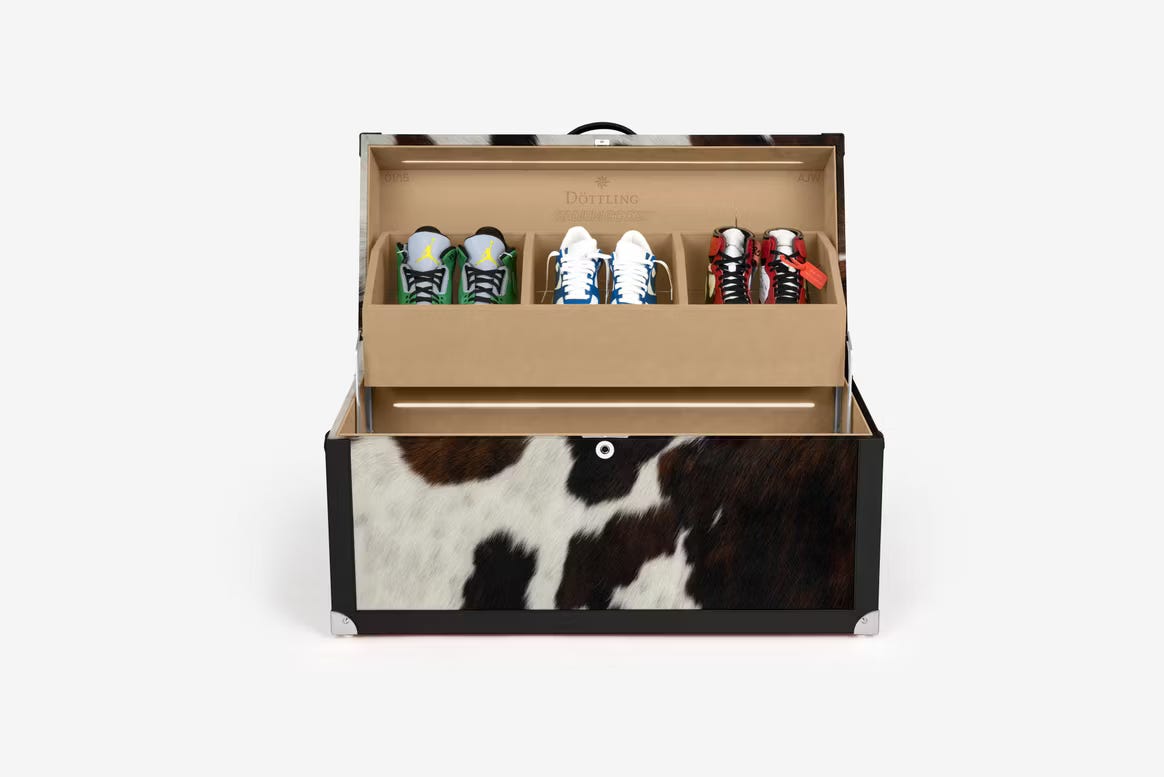
I’ll spare you most of the inside details, because those are stories for another day. But I will point you to this $26,000 sneaker safe as one example of the thinking that was happening while the company was quietly heading toward collapse. Stadium Goods, Farfetch, and German luxury manufacturer Döttling collaborated on a line of made-to-order calf leather sneaker safes, starting at $26,000 and going up to $29,500 in cowhide, sold exclusively on Farfetch. Fifteen total. That was a real product. That was a real priority. The same year, Farfetch’s stock was in freefall, and the clock on all of our equity was already running out, whether anyone admitted it or not.
Let’s just say the leadership made some other questionable choices, too. I’ll leave it there, because the courts are still sorting out the details. What I can tell you is that Farfetch’s former CEO José Neves, Group President Stephanie Phair, and CFO Elliot Jordan are now at the center of a High Court dispute, with liquidators raising concerns about what they describe as “serious mismanagement” and questioning why there was “such a rapid and drastic deterioration in the company’s finances” before the whole thing came apart. Those are the liquidators’ words, not mine. The executives have denied the allegations. But the story of how a company that was publicly stating it was in good financial health in August 2023 ended up in a fire-sale acquisition by December of that same year... that’s a story that deserves its own newsletter. Maybe more than one.
What I know from the inside is simpler: Stadium Goods had some truly incredible people working there. Talented, creative, genuinely passionate about sneaker culture and what the business could become. Somehow, leadership failed every single one of them. I watched a company that had built something genuinely meaningful... connecting luxury resale with sneaker culture, bridging two worlds that had a lot more in common than people realized... get consumed by the financial pressures of a parent company that had taken on too much. In early 2024, the weight of it came down. I was laid off. Stadium Goods was restructured. And the broader Farfetch empire, which had also held a minority stake in Off-White through its New Guards relationship, continued to unravel.
By September 2024, LVMH, which had acquired majority control of Off-White back in 2021, sold the brand to Bluestar Alliance. Bluestar is a New York-based brand management company. Their portfolio includes Palm Angels, Hurley, Bebe, Scotch & Soda, Brookstone, and most recently, my beloved… Dickies. These are not bad brands. But they are brands acquired specifically because their names still carry recognition even after the original creative energy has faded. That’s Bluestar’s business model. They’re good at it.
And so Off-White... the brand that Virgil built from the ground up, that redefined what a luxury streetwear collaboration could look like, that made the sneaker world reckon with art and architecture and the idea that design could be both academic and emotional at the same time... now belongs to the same company that owns Limited Too.
The Costco hoodies make complete sense in that context. They’re not a scandal. They’re just the logical endpoint of a brand that has been passed from balance sheet to balance sheet, losing a little more of its soul at each transfer.
The Pattern Has a Name
Off-White’s ownership odyssey isn’t an anomaly. It’s a template. And once you’ve worked inside this industry long enough, you start recognizing it before it plays out.
Reebok is the oldest and most instructive example. I’ve written about this in two different newsletters... once in 2020 when I was first trying to make sense of why a brand with Allen Iverson, Jay-Z, 50 Cent, Pharrell, Venus Williams, and an NFL partnership somehow collapsed at the moment it should have been unstoppable, and again earlier this year when I watched Reebok’s new ownership structure require a flowchart to understand who actually controls what.
The short version: adidas acquired Reebok in 2006 for $3.8 billion. They spent fifteen years trying to figure out what to do with it. They couldn’t. In 2021 they sold it to Authentic Brands Group for $2.5 billion... a billion-dollar loss, not counting the opportunity cost of fifteen years of mismanagement. ABG then layered licensing deals on top of licensing deals, eventually producing a structure so complex that Galaxy Universal now handles product creation and sourcing while separate entities run European operations, and Reebok is somehow also making Bluetooth smart glasses, albeit through licensing partnerships. The Question Mid helped define the intersection of basketball and hip-hop culture for an entire generation. The brand that carried it is now licensing its name to tech eyewear. To me, that signals exactly how far a brand can drift when the people making decisions have no memory of what made it matter in the first place.
Supreme is the more recent cautionary tale. VF Corporation acquired Supreme in 2020 from The Carlyle Group for $2.1 billion. VF already owned Vans, The North Face, Timberland, and Dickies. They promised to maintain Supreme’s “unique culture and independence.” Founder James Jebbia stayed on. Everyone said the right things.
Four years later, VF sold Supreme to EssilorLuxottica... the optical giant that owns LensCrafters, Sunglass Hut, Ray-Ban, and Oakley... for $1.5 billion. Six hundred million dollars less than they paid. Supreme, the brand that had defined what scarcity and cultural credibility could look like in streetwear for thirty years, now belongs to a company whose core business is making glasses.
The pattern is always the same. A culturally significant brand gets acquired by a larger entity that believes its financial and operational scale will unlock growth. Promises are made about independence and heritage. The people who understood the culture either leave voluntarily or get reorganized out. The brand becomes a logo licensing operation. The valuation erodes. Someone buys the diminished version at a discount… the cycle starts again.
I watched this up close. When Farfetch acquired New Guards Group, every brand in that portfolio was affected. Off-White lost Virgil. Palm Angels ended up in outlet stores. Heron Preston bought his brand back. Opening Ceremony closed entirely. And Stadium Goods went from a high-end cultural retail experience to selling product on TikTok and Walmart. As I wrote when this was still raw: Off-White without Virgil is a logo licensing operation. The Costco hoodies are simply the proof.
What none of these acquirers ever seems to understand is that the thing they’re buying isn’t the logo. It’s the point of view behind the logo. And point of view doesn’t transfer in a term sheet.
