

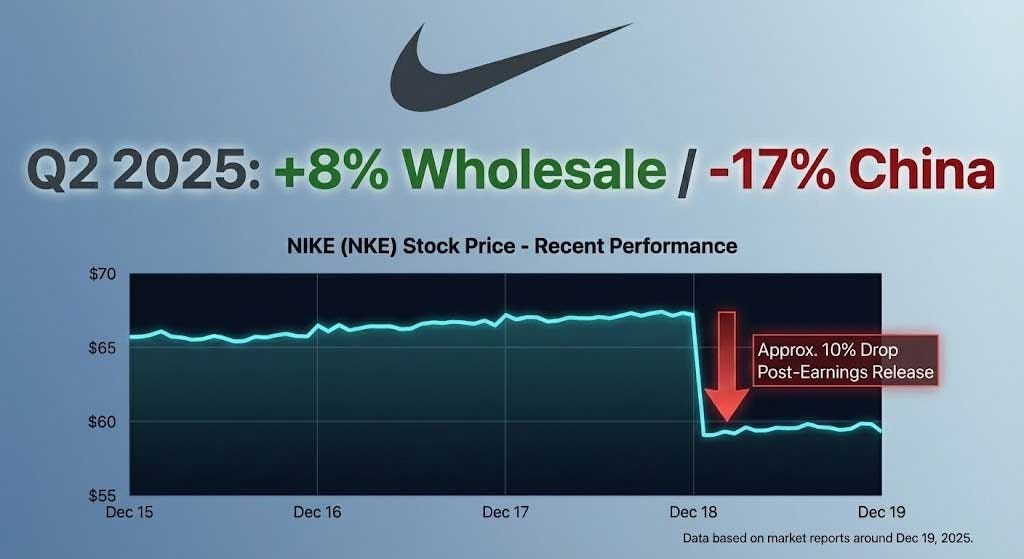
The stock market hates what it saw in Nike’s Q2 earnings. Down 10% the day after. But if you’re only looking at the headline numbers, you’re missing the actual story.
Nike dropped Q2 earnings Thursday and Wall Street panicked. Stock down 10%. China collapsing. Margins squeezed. But the market completely missed what’s actually happening... and where the real opportunities are.
Elliott Hill keeps saying Nike is in the “middle innings” of their comeback. After digging into these results, I’m starting to see what he means... and where the real opportunities might be hiding.
The Wholesale Comeback Is Real (And It Matters)
Let’s start with what’s actually working.
Wholesale revenues climbed 8% to $7.5 billion while direct sales fell 8% to $4.6 billion.
This isn’t just a stat. This is Nike admitting that the Consumer Direct Offense... the strategy John Donahoe bet the entire company on... was fundamentally flawed. And more importantly, they’re fixing it.
Hill’s return to wholesale isn’t weakness. It’s pragmatism. For years, Nike treated Foot Locker, Dick’s Sporting Goods, and other retail partners like they were lucky to carry the swoosh. Then Hoka, On, and New Balance happily filled that shelf space while Nike tried to force everyone to Nike.com.
Now Hill’s rebuilding those relationships, and the 8% wholesale growth shows retailers actually want Nike back. North America grew 9% to $5.63 billion, driven almost entirely by wholesale momentum. This should also get at least some of the sneakerhead community excited, too.
I was at StockX during Nike’s initial wholesale pullback. We watched in real-time as other brands capitalized on abandoned retail relationships. The fact that Nike can walk back in and immediately post 8% growth tells you two things: their brand power is still massive, and retail partners were waiting for them to come to their senses.
The real question is whether Nike learned the lesson... you can’t build a sustainable business by declaring war on the channels where most people actually buy shoes.
Based on Q2, it looks like they finally get it.

The China Problem Requires Creative Solutions
Now the hard part. Greater China revenue dropped 17% to $1.42 billion, with Nike Digital down 36%.
That’s brutal. And Hill was honest about it on the earnings call, admitting improvements are “not happening at the level or the pace we need to drive wider change.”
But here’s where it gets interesting. While Nike struggles, adidas reported 10% growth in China during their Q3. Same market, same consumer, opposite results.
The difference? adidas didn’t spend years training Chinese consumers to wait for digital discounts. Nike did. According to Investing.com’s earnings analysis, the marketplace has been “consistently off-price for consumers, especially in digital, affecting our premium positioning across the entire integrated marketplace.”
You can’t premium-price your way out of a hole you dug by devaluing your own brand.
So how does Nike compensate for losing ground in what should be one of their biggest markets?
The math is uncomfortable. Greater China was doing roughly $1.42 billion per quarter even in decline. If that continues deteriorating, Nike needs to find $6 billion+ annually from other sources just to stay flat.
North America can’t carry that load alone. EMEA is down 1%. Running growth is real but can’t offset an entire region’s collapse.
Which brings me to the question nobody’s asking...
