
Foot Locker's $189K Liquidation Wasn't a Mistake... Or Was It?
A bet on sneakers made months ago is now worth a fraction of what it was and I think it says a lot.

I saw a TikTok post this week that stopped me mid-scroll.
Foot Locker is selling $189,000 worth of sneakers for $37,000.
Everyone in the comments saw a deal. I saw a business decision made 6-9 months ago that looked smart at the time... and then the market shifted.
This isn’t unusual. Liquidation happens constantly in retail. We just usually see it at Ross, Marshall’s, and Burlington instead of being talked about as “Foot Locker’s inventory.” But the scale here tells a story. And it’s something the industry needs to understand... and if you’re a sneakerhead, you should be paying attention for different reasons.
Retail 101: Why Inventory Velocity Matters More Than You Think
For anyone thinking about opening a sneaker store, or anyone who wonders why retailers seem to always be having sales, understand this: holding inventory is expensive.
Every pair of shoes sitting in a stockroom costs money. Storage space costs money. The capital tied up in those shoes could be invested elsewhere. And in sneakers specifically, styles go out of season faster than almost any other product category. What’s heat in January is sitting on shelves by March.
This is why smart retailers obsess over something called inventory turn rate… how quickly products move from delivery to sale. The faster you turn inventory, the healthier your business.
The math is simple, even if the psychology isn’t: selling a shoe at 60% off today is almost always better than hoping to sell it at full price six months from now. Because in six months, that shoe isn’t worth full price anymore. The market has moved on. New models have dropped. Trends have shifted.
That $200+ Jordan sitting in your stockroom today might be worth $180 in three months, $140 in six months, and $89.99 at Ross in nine months.
So when Foot Locker liquidates $189K in inventory for $37K, they’re not being stupid. They’re responding to a market that went cold on them. The buyers who ordered this inventory couldn’t have known the market would slow down this much.
The Store That Taught Me This Lesson
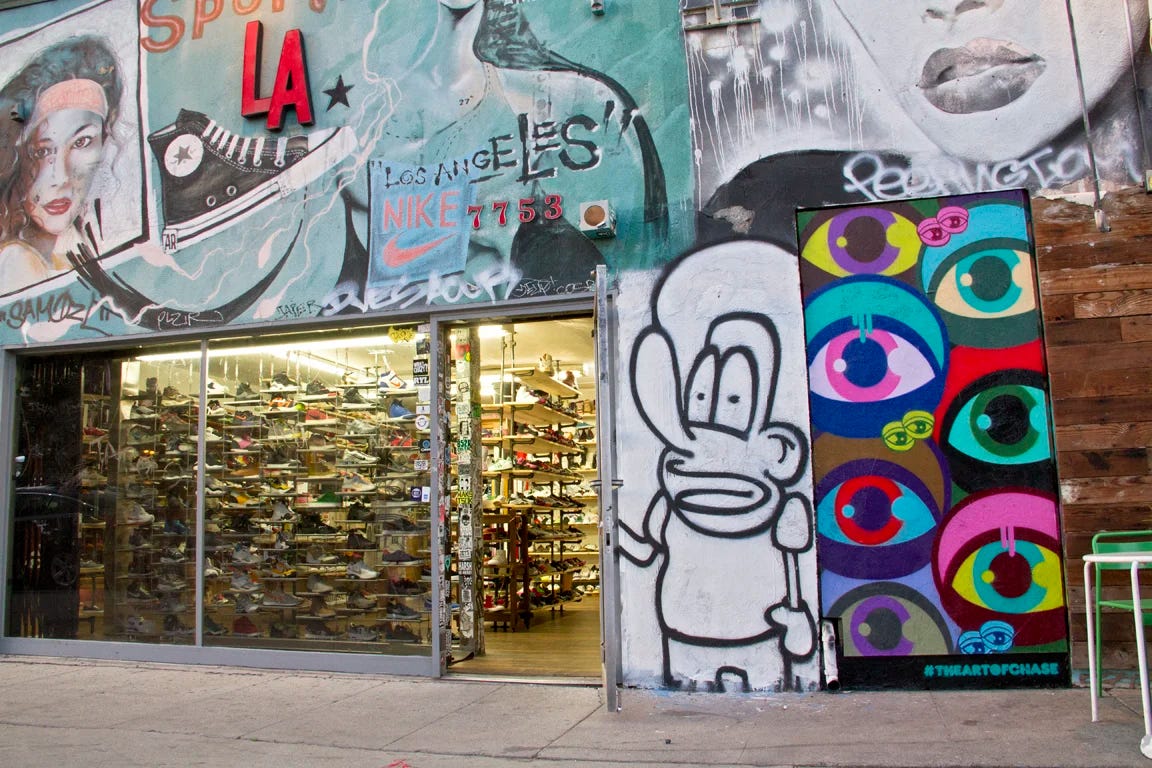
There used to be a store in Los Angeles called Sportie LA (at least it seems to be out of business online). The main location on Melrose had shoes from decades back, sitting in windows, covered in dust, some discolored from the sun. And they still charged full price.
I loved going in there. It was like a museum. But I don’t think I ever bought a pair from the main store.
They had a discount location in the Little Ethiopia neighborhood of LA on South Fairfax called Sneaker Joe’s. My friend Alexander and I would go there all the time, literally climbing the shelves to dig through boxes stacked behind other boxes. We’d find Made In USA Converse, Saucony from the early 2000s, old adidas ZX runners that nobody had seen in years.
I became friendly with the uncle who ran Sneaker Joe’s. He’d let us dig for hours, knew we were serious, appreciated that we understood what we were looking at.
I loved those hunts. The thrill of finding something rare, something forgotten, something nobody else knew was there.
But even then, I understood what I was really looking at.
Those “treasures” were inventory decisions from years prior that got caught in a changing market. Every amazing find we made represented a shoe that Sportie LA bought with good intentions, then couldn’t sell when trends shifted. Some of those boxes had been sitting for five, ten, even fifteen years.
The lesson Sportie LA never learned: markets move faster than hope. Holding onto inventory betting the market will come back almost never works. Especially in sneakers.
Eventually, Sneaker Joe’s closed. As for Sportie LA, from people I’ve asked, the store is still open but the online presence is pretty much gone.
When Liquidation Is Strategy vs. Response
I wrote a few weeks ago about how Dick’s Sporting Goods handled their inventory problem. They got aggressive, cleared shelves, made tough decisions about what to cut loose and what to keep. It was strategic, deliberate, and ultimately necessary for their survival.
Foot Locker is doing something similar here. And honestly? This is the right move given where the market is.
When you’re liquidating at 80% off, you’re not optimizing margins. You’re acknowledging reality and moving forward.
What This Really Tells Us About The Market
From my time at StockX and Stadium Goods, I learned that inventory tells you everything about market conditions… not just company decisions.
The buyers who ordered this inventory did so at least 6-9 months ago, maybe longer. They were making bets based on the data they had at the time. They were projecting trends, anticipating demand, committing capital.
And then the market slowed way down. Not because they were bad at their jobs, but because the entire sneaker market has cooled off.
We’ve seen it in the data all year. Resale markets are down. General releases are sitting. Even limited drops aren’t moving the way they used to. Consumer spending has shifted. Inflation hit. Interest rates changed behavior. The sneaker market that existed when these orders were placed isn’t the same market that exists now. People are claiming that sneakers are dead.
Maybe the buyers over-indexed on certain styles. Maybe they couldn’t predict how dramatically Nike’s DTC strategy would affect their allocations. Maybe they bet on a market recovery that didn’t materialize as fast as anyone hoped.
But mostly? They’re dealing with the same reality every retailer is dealing with right now: people aren’t buying sneakers the way they used to.
That’s not a Foot Locker problem. That’s an industry problem.
And liquidation is the healthiest response to that reality. Better to cut losses, free up capital, and buy smarter for the market that actually exists rather than the market you wish existed.
The Lag Time Nobody Talks About
Here’s what most people don’t understand about retail downturns… the impact doesn’t happen overnight.
Everyone talks about “overnight success” taking years to achieve. The same is true in reverse. Market failures unfold slowly, across months and quarters, touching every part of the supply chain at different times.
When consumer spending starts to slow, it doesn’t immediately show up as a retail problem. First, consumers just browse a little longer before buying. They wait for sales. They skip the impulse purchases. Retailers notice foot traffic is steady but conversion is down. Not alarming yet. Just... softer.
Then, a few weeks later, retailers realize they’re not hitting their weekly sales targets. But they’ve got upcoming product launches, holiday seasons, promotional events planned. They stay optimistic. Maybe it’s just a weird week. Maybe next month picks up.
Meanwhile, manufacturers are still producing shoes based on orders placed 6-9 months ago, when the market looked completely different. Factories in Asia are making shoes for a demand level that no longer exists. Those shoes are already in production, already in containers, already on ships crossing the Pacific.
By the time retailers realize the slowdown is real and start cutting orders, it’s too late. The inventory is already in motion. The shoes they ordered back when the market was hot are arriving at a moment when consumers have cooled off.
Then you compound the problem. Those shoes arrive, they sit, and now the retailers have less capital to commit to new inventory. Less capital means smaller orders going forward, which means manufacturers start feeling the squeeze months later. Factories that were running at full capacity start laying off workers. Production schedules get cut.
And consumers? They’re the last to really feel it, but they do eventually. Prices stay higher longer because retailers are trying to preserve margin on inventory that’s not moving. Innovation slows because brands don’t have the capital to take risks on new designs. The variety on shelves shrinks because buyers are playing it safe, only ordering proven sellers.
This is why you see liquidation sales like Foot Locker’s now, in late 2025, for inventory ordered in early-to-mid 2025, based on market conditions from late 2024. The shoes arriving today were committed to when everyone thought the market would stay hot.
It’s not an overnight failure. It’s a slow-motion chain reaction that touches manufacturing, shipping, retail, and eventually consumers, each feeling the impact weeks or months after the previous link in the chain.
The buyers at Foot Locker couldn’t have known. Nobody could have. By the time the market signals were clear enough to act on, the inventory was already committed, already in production, already on its way.
That’s the reality of retail. You’re always making bets on a future you can’t see, with information that’s already outdated by the time the product arrives.
The Uncomfortable Parallel I Can’t Ignore
Embarrassingly, this reminds me of something I need to admit. I’ve made similar decisions with my own collection.
I’ve been holding onto hundreds… maybe thousands… of shoes for decades. Storage units. Garages. Bedrooms. Closets. Every available space I had.
I told myself I was preserving history. Building an archive. Maintaining a collection that represented 20 years in this industry.
And some of that is true.
But a lot of it? I was holding on because I bought during a different time and letting go now feels like admitting my own failure.
The difference between me and Sportie LA is that I selling shoes is not my business. They thought they were preserving value. I know I’m holding onto a moment that’s passed, unable to let go because these shoes represent more than just product to me.
Every shoe I’m storing is capital I can’t deploy elsewhere. Every box taking up space is space I can’t use for something more valuable. Every decision to “hold onto it a little longer” is a decision not to adapt to current reality.
The parallel to retail is exact. Just smaller scale and more personal.
And just like those buyers at Foot Locker, I’m not wrong for the decisions I made when I made them. At least in my case, the storytelling packed away in boxes will always be something I can dive into, enjoy, and share with the community.
The Lesson Available For $37K
Foot Locker’s $189,000 lesson is available for $37,000.
The real question is: who’s willing to learn from it?
For retailers: Inventory velocity matters more than margin preservation when the market shifts. A sold shoe at 40% off is worth more than an unsold shoe at full price. Always. The cost of holding… in capital, in space, in opportunity… compounds daily. And in a slow market, that cost accelerates.
For buyers: You can make all the right decisions based on available data and still end up with inventory that doesn’t move. That’s not failure… that’s the risk inherent in retail. The key is responding quickly when you realize the market has changed. And understanding that by the time you realize it, you’re already dealing with inventory committed months ago.
For manufacturers: The lag time between orders and market reality is brutal. What looked like smart production levels six months ago can become oversupply today. The companies that survive are the ones with flexible production and strong communication with retail partners.
For collectors: There’s a line between collecting and holding onto the past. I’m still figuring out where that line is for myself, but I know it exists. And I know that holding onto things because of what the market used to be rarely works out the way we think it will.
For the industry: This is what happens when the entire market cools. It’s not about one retailer making mistakes. It’s about an industry built on long lead times and advance commitments getting caught in a market shift. The companies that survive are the ones that acknowledge reality and adjust quickly.
For sneakerheads: This isn’t just Foot Locker. If the market is this cold, expect liquidations across the industry over the next few months. That inventory has to move. The deals are coming.
Liquidation isn’t a failure. It’s an acknowledgment that markets change and the smart move is to adapt rather than hold on hoping for a return to what was.
The failure would be keeping that $189K in inventory on the books, paying to store it, tying up capital, waiting for a market recovery that might not come… or might come too late to matter.
We just usually see the evidence at Ross and Marshall’s instead of in Instagram posts about Foot Locker.
But the lesson is the same either way: in retail, adapting to current market conditions costs less than waiting for the market you wish existed.
Even if adapting means taking an 80% loss.
Because that loss was locked in months ago. The only question is when you acknowledge it.
I’m Nick Engvall, and I’ve been writing about sneakers and culture for nearly two decades, from building Eastbay’s first blog to being employee #9 at StockX. I run Sneaker History (website and podcast) and write The Sneaker Newsletter... the stories that connect what we wear to who we are. Markets change slowly, then all at once. The question is: do we adapt when we see it coming, or wait until it’s already here?
Dang, I felt this section down deep in my bones:
"Every shoe I’m storing is capital I can’t deploy elsewhere. Every box taking up space is space I can’t use for something more valuable. Every decision to “hold onto it a little longer” is a decision not to adapt to current reality."