

I spend most of my time zoomed in. I love this world too much not to.
The new colorway, the brand pivot, the earnings call, the collaboration that either makes sense or doesn’t. That’s the work, and I think it’s valuable... understanding the industry from the inside out, with context most people covering sneakers don’t have.
But every once in a while, you have to zoom out.
Not to the 30,000-foot view where everything becomes vague and theoretical, but to the altitude where you can see the terrain sneaker consumers are actually navigating. The economy they wake up in every morning. The cost of groceries they’re thinking about when they’re standing in your store, or scrolling your app, or deciding whether that $160 shoe is a yes or a not right now.
That’s what this piece is about.
This past week, I’ve been spending time with the latest data from The Conference Board’s Consumer Confidence Survey, released April 28, 2026, and what it shows has real implications for anyone in this industry. Not panic-inducing... but important. The kind that separates brands and retailers who are paying attention from the ones who are going to be surprised when Q3 numbers come in light.
Let me show you what I’m seeing..
The number that actually matters
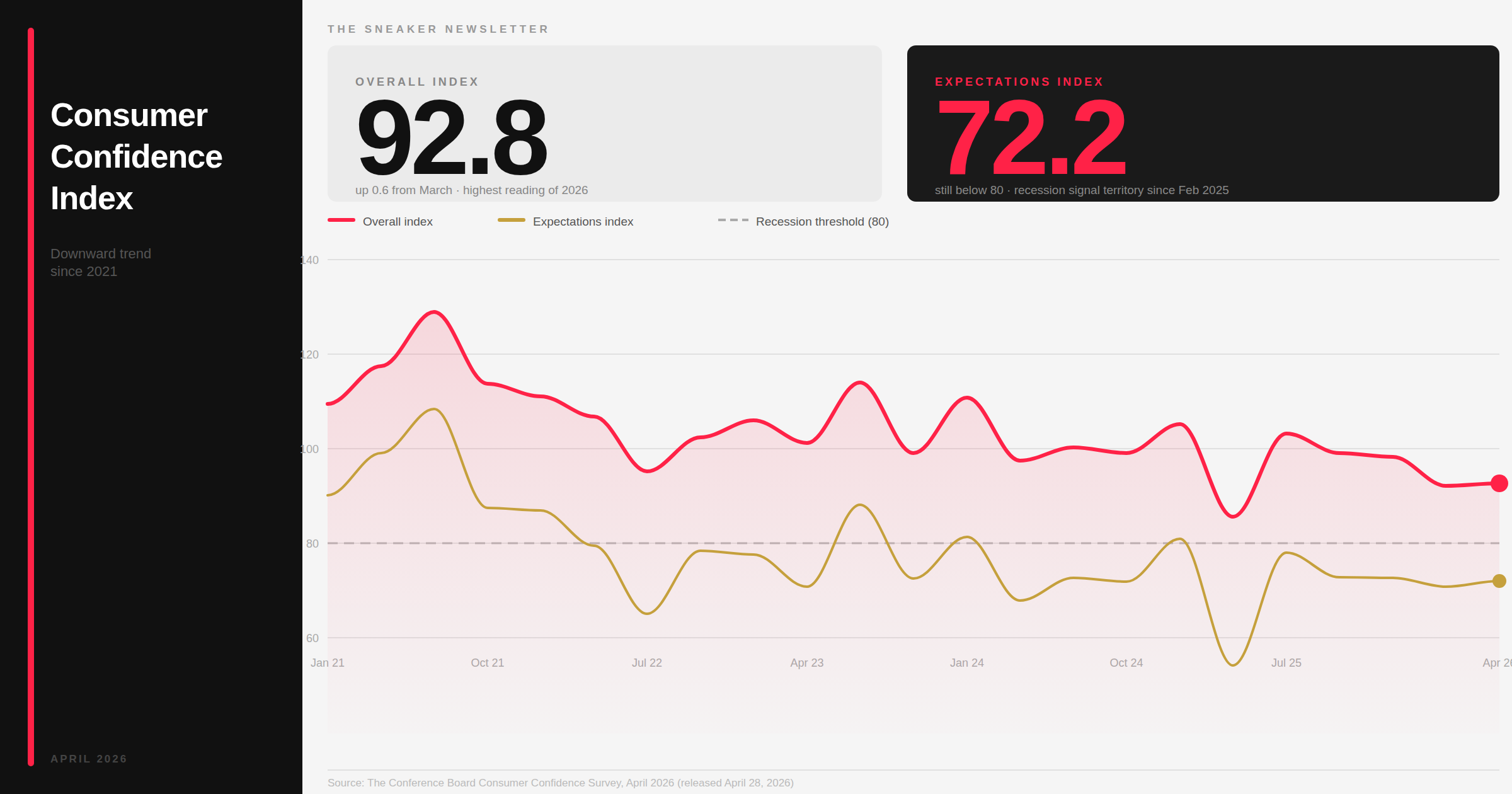
The headline Consumer Confidence Index came in at 92.8 in April, up a modest 0.6 points from March. That’s actually the third consecutive monthly gain, and the highest reading of 2026. It also beat analyst expectations of 89.0 by a meaningful margin. On the surface, that sounds like good news.
But the headline number isn’t the number I’d be watching.
The number I’d be watching is 72.2.
That’s the Expectations Index... the component that measures how consumers feel about where things are headed six months from now. Jobs, income, business conditions. And historically, when the Expectations Index falls below 80, it’s a reliable signal that a recession is on the horizon. It’s been below 80 since February 2025. In April it ticked up 1.2 points to 72.2... still well inside recession-signal territory. Fifteen consecutive months below that threshold, if you're keeping count.
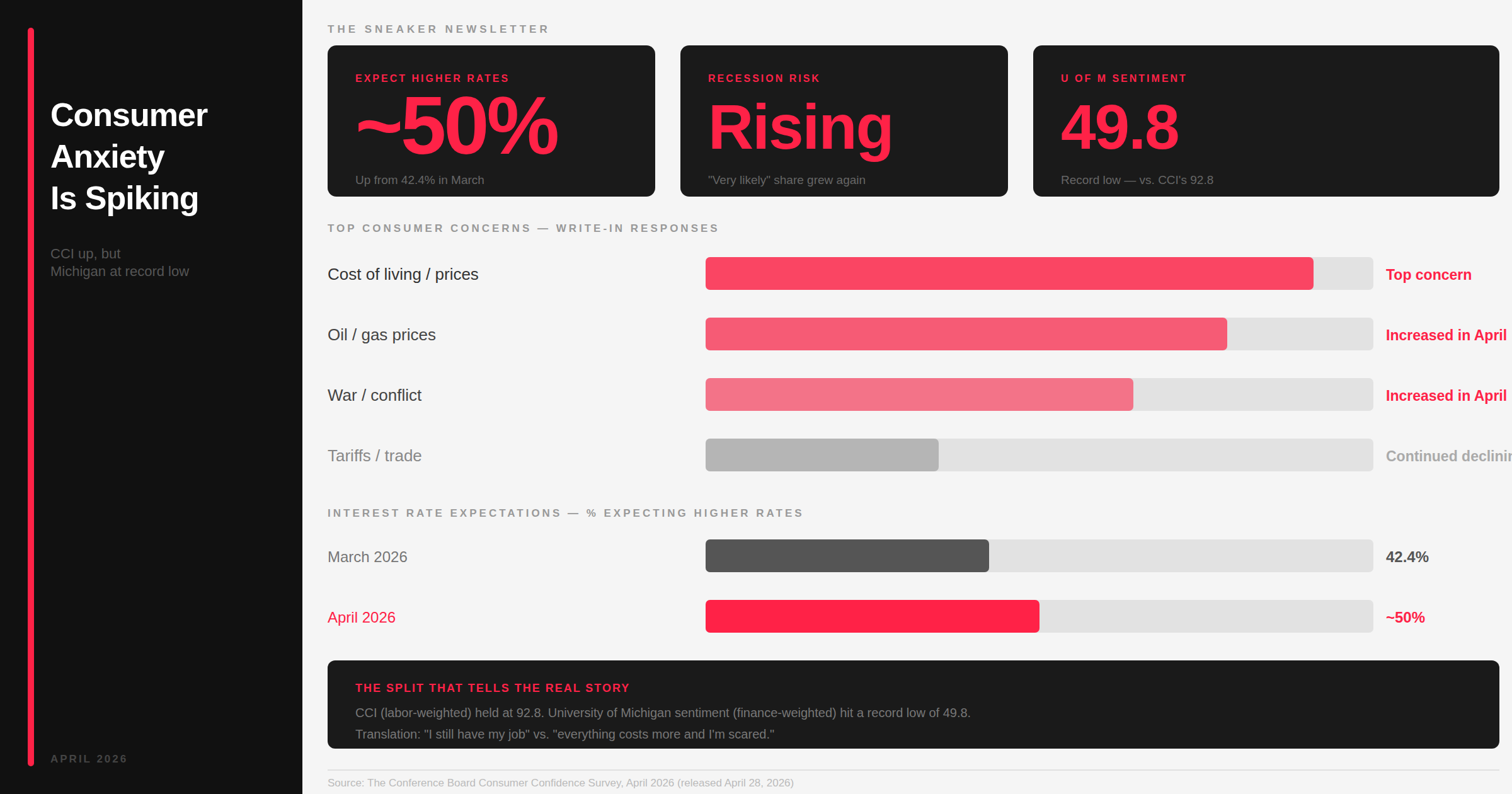
There’s something else worth paying attention to here. The same week the Conference Board index edged up, the University of Michigan Consumer Sentiment Index dropped to 49.8. A record low. The weakest reading since the survey began in 1978. Lower than the financial crisis. Lower than COVID. Lower than the inflation spike that followed Russia’s invasion of Ukraine. The two indices measure different things: the Conference Board is weighted toward labor market conditions, while Michigan is more sensitive to personal finances and cost of living. The gap between them right now is the widest it’s been in years.
Surveys of Consumers Director Joanne Hsu noted that the decline was universal — across every income level, every age group, every level of education, and every political affiliation. That last part is worth sitting with. This isn’t partisan anxiety. We’re all on the same team right now, whether we realize it or not.
Thhat signals a consumer who still feels okay about their job, but is genuinely scared about what things cost. That’s a specific kind of spending pressure that hits discretionary purchases hard... and sneakers are a discretionary purchase.
Where sneakers live in the consumer’s mind
Here’s the question I kept coming back to while looking at this data and if you’re in the business, I think it’s the question you should be asking too: where do sneakers actually fit in how consumers are prioritizing their spending?
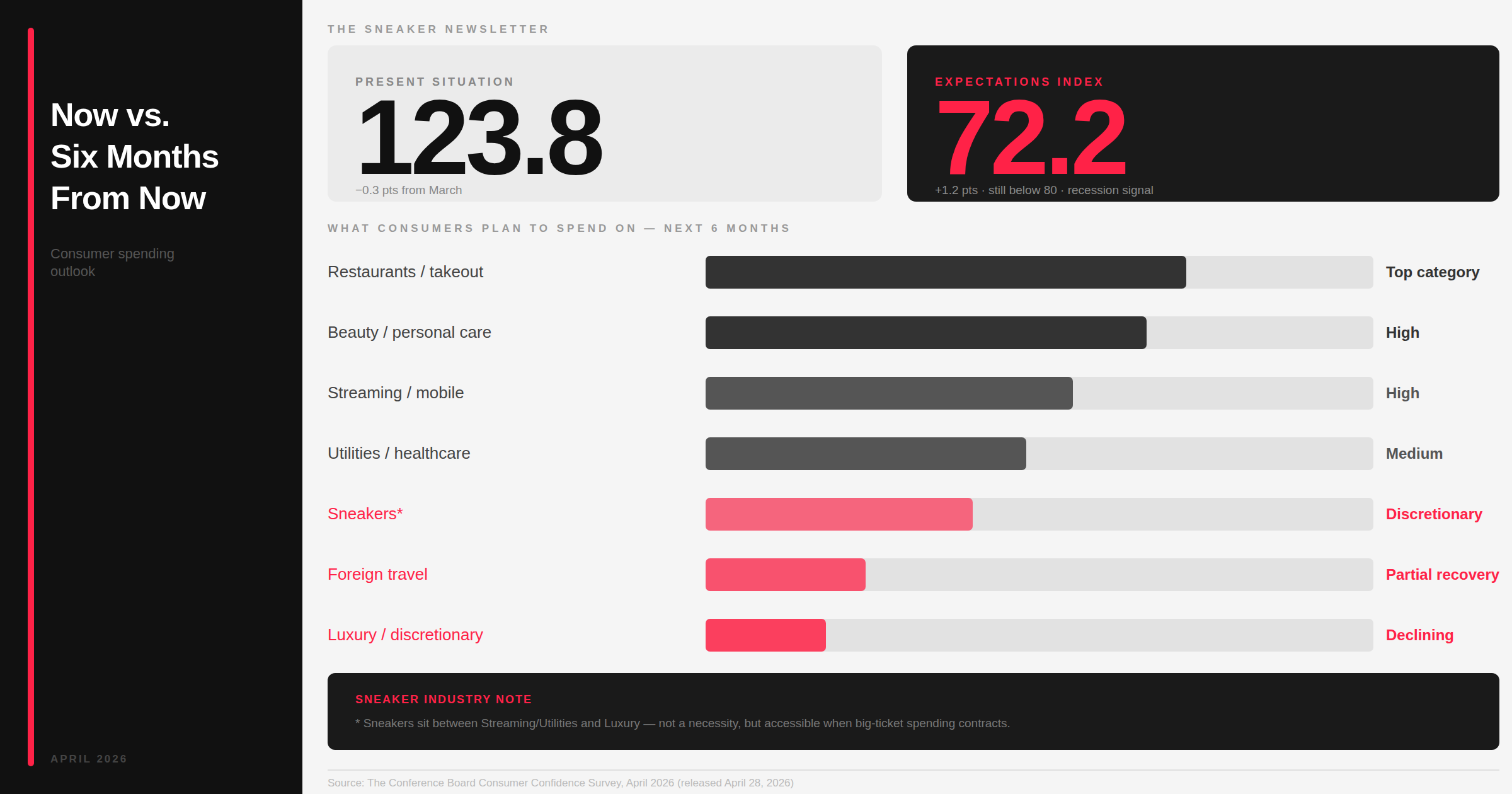
The April survey shows restaurants and takeout holding as the top spending category. Beauty and personal care moved up. Streaming and mobile services remain strong. Utilities and healthcare ranked above hotel and motel for personal travel, which tells you something about how people are thinking about their money.
Sneakers sit in an uncomfortable position in that hierarchy.
They’re not a necessity, which means they don’t have the floor that groceries or utilities have. But they’re also not a vacation or a luxury handbag, which means the ceiling of their aspiration stays within reach for a lot of people. A $130 shoe feels possible when a $3,000 trip doesn’t.
To me that signals the mid-tier sneaker market, roughly $90–$180, is going to hold better than the extremes over the next two quarters. The $400 limited release faces real headwinds when consumers are quietly bracing. The $70 everyday runner is actually well-positioned, which is exactly why GOAT launched Sneakers.com, a platform averaging $70 per order, in direct response to where consumer appetite is right now. I wrote about what this shift looks like from the European retail perspective a few weeks ago. And if history holds, the US follows Europe on footwear trends by about twelve to twenty-four months.
The brands reading this market correctly are the ones already leaning into value without abandoning identity. The brands still planning Q3 around the assumption that heat alone drives purchase are going to feel this data in their sell-through numbers.
The anxiety underneath the numbers
There’s a layer to this data that goes beyond the headline figures, and it showed up in the survey’s write-in responses... what consumers are actually thinking about when they think about the economy.
In April, write-ins about prices, oil and gas, and war all increased in frequency compared to March. The Conference Board specifically noted that the Middle East conflict is driving gasoline price anxiety, even as a temporary ceasefire during the survey period helped stabilize sentiment slightly. Inflation expectations ticked down marginally but remained elevated. The percentage of consumers expecting interest rates to be higher a year from now climbed to nearly 50%.
Read that again. Half of American consumers expect rates to be higher. The share saying a recession is “very likely” grew again in April.
This matters for sneakers specifically because of what’s sitting upstream in the supply chain. Nike produces roughly 50% of its footwear in Vietnam. adidas is at about 39%. UBS analysts estimated earlier this year that offsetting Vietnam tariffs alone would require retail price increases of 10–12%.
Those costs are coming. The only question is who absorbs them and how much gets passed to the consumer who is already telling you, in survey after survey, that cost of living is their top concern.
This is where the macro picture ends and the industry analysis begins. Below the paywall: what the resale market data tells us about where brand heat is actually shifting, what this data means for the three tiers of the sneaker market, and the first details on something I’ve been building quietly that I think is going to be genuinely useful to everyone reading this.