

The NASCAR Boxes
If you missed Parts 1 and 2, the short version: I’ve been collecting Formula 1 and racing footwear since the late 1990s. Part 1 opened boxes on Williams, FILA Schumacher, Reebok, K-Swiss McLaren, and the current wave of collabs. Part 2 told the full Nike story, the race boot, the Air Zoom Schu, the complete four-product Schumacher signature program, and what it might mean that Nike Dunks just showed up in a Cadillac garage in Barcelona. If you want the long version, start there.
This is the final part of this series for now. There’s more in the collection to share at another time, and if you’ve been reading along, you know by now that my obsession doesn’t stop at racing. There are more boxes. More stories. More product that deserves more credit than it ever got. But that’s for another day.
These boxes go somewhere else entirely.
Now let’s make a right turn.
Formula 1 and NASCAR have almost nothing in common stylistically, strategically, or culturally. That extends to how they’ve approached footwear partnerships. F1 has always had a European precision about it: the relationship between team aesthetics and brand identity, the paddock as a catwalk, the driver as a style reference. NASCAR’s footwear history is messier, more regional, more personal. And in some ways more interesting because of it.
To understand why Nike was building driver exclusive shoes for NASCAR stars in the early 2000s, you have to understand where the sport sat in the American cultural landscape at that moment. In 2005, NASCAR was the second most-watched sport in the country behind only the NFL. The 2006 Daytona 500 drew nearly 19.4 million viewers, the largest audience in the race’s history. Fortune 500 companies were in a bidding war to put their logos on the hood. CART and IRL, the two competing open-wheel series in America, were fighting over a shrinking audience and cannibalizing each other. F1 in the US was barely a footnote, pulling a few hundred thousand viewers on cable, a sport that felt distant and irrelevant to most of the country.
Nike knew exactly where the audience was. And they went there. Driver by driver, team by team, championship by championship. The shoes in these boxes are the physical record of that commitment.
I have a handful of NASCAR shoes that deserve a moment. And I’ll be honest with you: if the history of NASCAR footwear deserves a full deep dive on its own, it might get one. But for now, here’s a peek at what’s in the boxes.
Nike Air Sub — Bobby Labonte, Winston Cup Champion (2000)
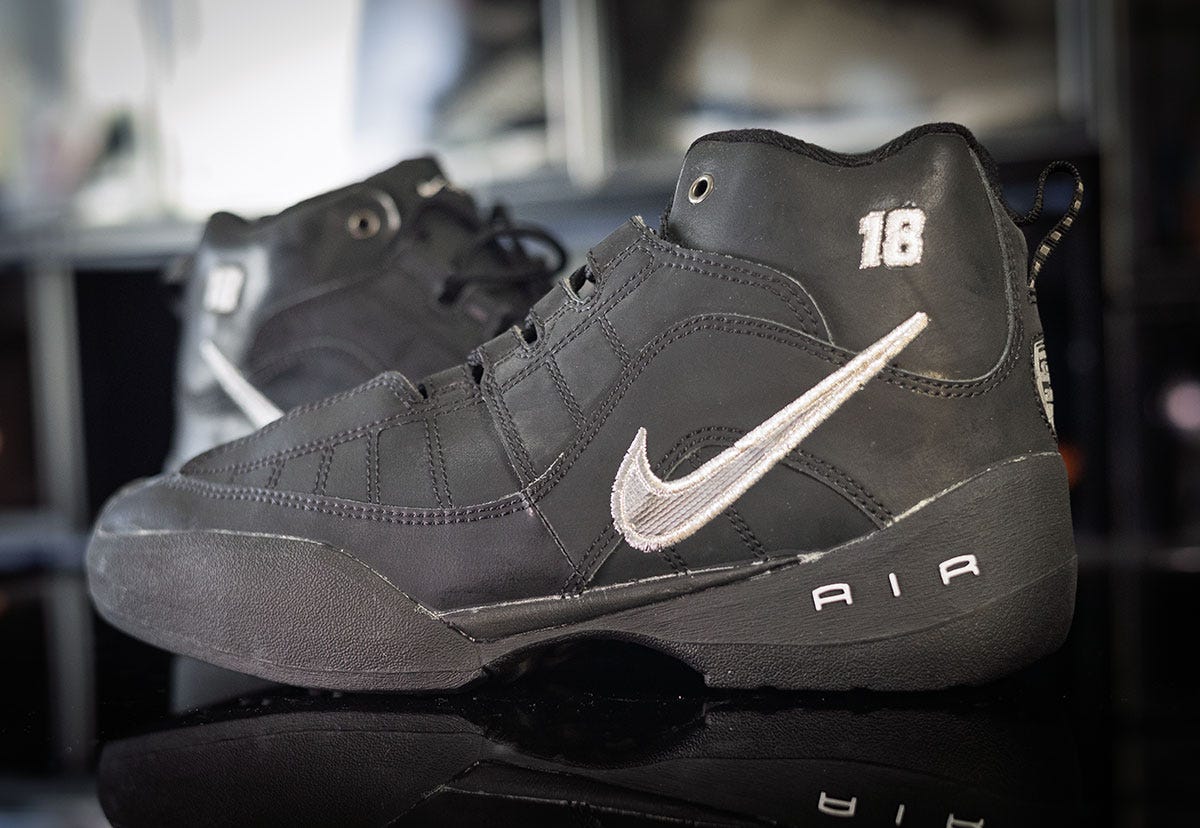
This one is understated and specific in the best possible way. All-black nubuck mid-top, silver embroidered Swoosh, #18 on the collar. The real detail is the heel medallion: “Bobby Labonte NASCAR Winston Cup Series 2000 Champion.”
Bobby Labonte won the 2000 Winston Cup Championship driving the #18 Interstate Batteries Pontiac Grand Prix for Joe Gibbs Racing. It was the first championship for Joe Gibbs Racing, and Labonte was one of the more quietly dominant drivers of that era. Consistent, technically sound, never quite the flashiest name but always in contention. Nike put his championship on a heel medallion and issued a commemorative shoe. That’s the kind of thing that only makes sense if Nike was fully committed to NASCAR as a platform at that moment in time.
The ACG outsole on this is interesting too. That’s not a racing-specific sole, it’s lifted from Nike’s All Conditions Gear line. Which tells you this was designed for everywhere except the track. A celebration shoe, not a performance shoe.
ACG… All Conditions Gear… launched in 1989 as Nike’s dedicated outdoor performance division. The timing matters: this was Nike at its most experimental, the same era that produced the Air Max 1, the Air Huarache, the Jordan line in full swing. ACG was where they sent the designers who wanted to go further. Tinker Hatfield, the same Tinker Hatfield who designed the Air Jordan 3 through 15, created the Air Mowabb in 1991, a cross-training hiking hybrid inspired by trips to Moab, Utah, with a speckled midsole, a neoprene ankle collar, and an outsole built around the mantra “leave no trace.” It appeared on Seinfeld the same year it released. The ACG design team in the 1990s was widely considered Nike’s most creative and experimental unit, producing the Air Mada, the Lava Dome, the Humara, shoes that sneakerheads in Tokyo and London were quietly collecting a decade before gorpcore became a word anyone used in fashion. The outsole on this Labonte shoe is a piece of that lineage. A motorsport shoe quietly borrowing from Nike’s most adventurous division.
ACG eventually drifted into lifestyle territory, its identity blurring as it bounced between performance and streetwear without fully committing to either. Nike just relaunched ACG in February 2026 as a dedicated outdoor performance brand, using the Winter Olympics in Milan as the platform, framing it explicitly as a return to functional roots. The relaunch has been one of the more talked-about brand moves of the year. The Labonte shoe with its ACG outsole is a small footnote in that long arc: Nike reaching across its own internal divisions to build something specific for a specific moment. That cross-divisional impulse is the same one that produced the Schumacher program. It just never got named the same way twice.
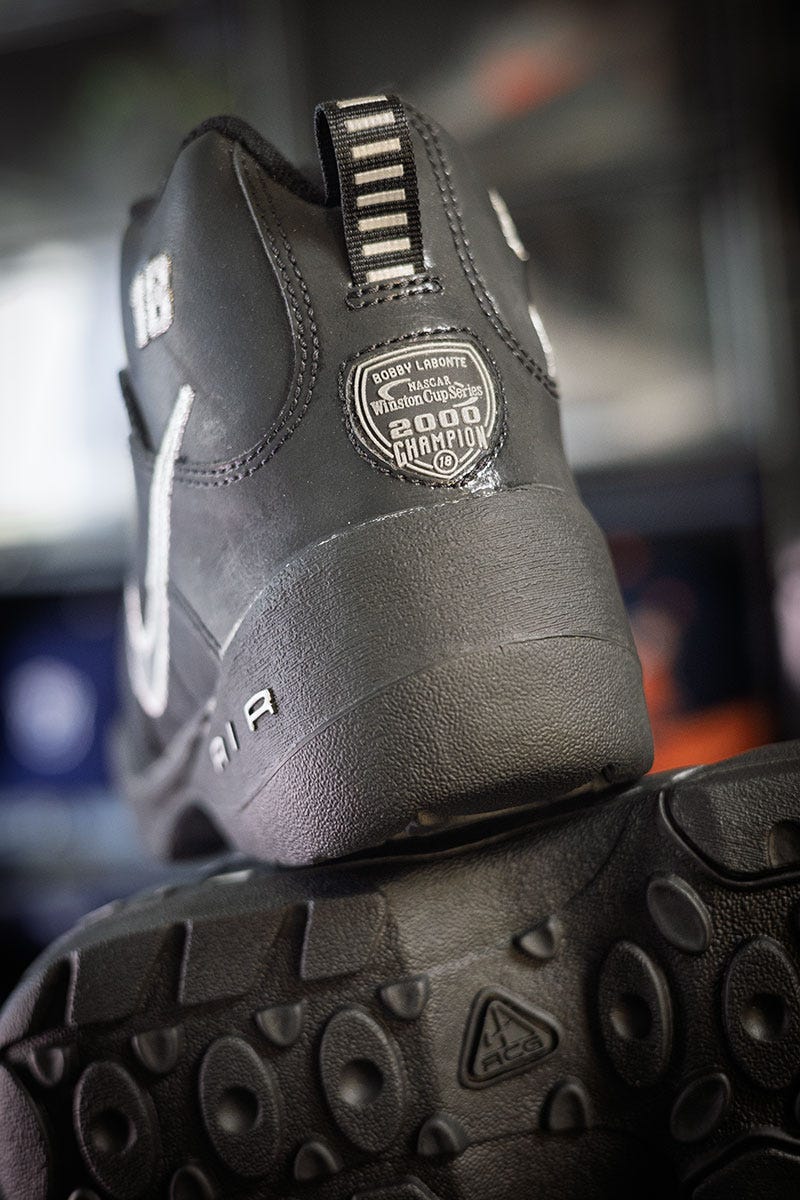
The ACG connection here is fascinating, and will probably have to be a full deep dive at some point in the future. I have more ACG, Starter, and Nike Racing shoes to share that fit this same story but for this story I want to focus on the athlete commitment, versus the variations in the product throughout this time.
Nike Zoom Pro Drive — Dale Jarrett (2002)
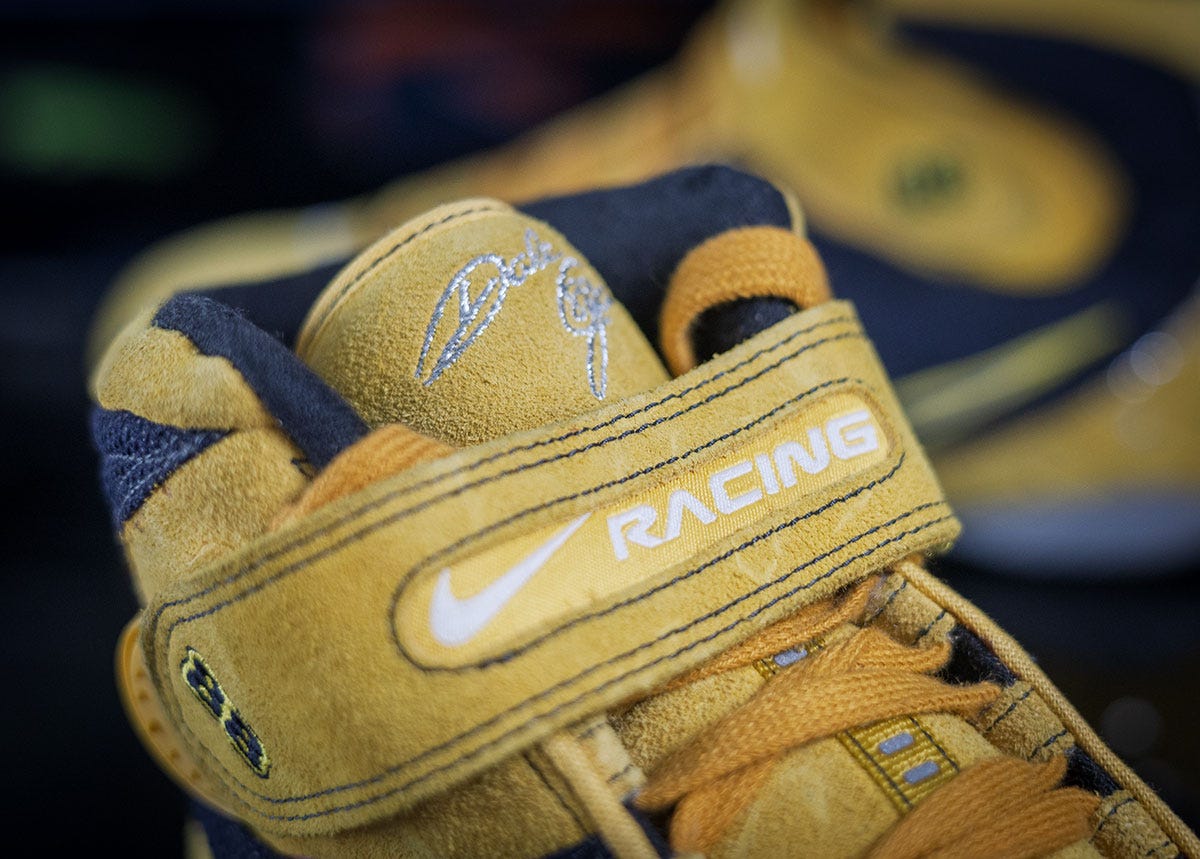
Dale Jarrett’s Nike shoe is the one that makes people stop when they see it. Gold and yellow suede upper with navy mesh, #88 on the Velcro strap, Dale Jarrett’s embroidered signature on the tongue. The UPS and Robert Yates Racing era colors: that unmistakable gold and navy that defined the #88 car through the late 1990s and early 2000s.
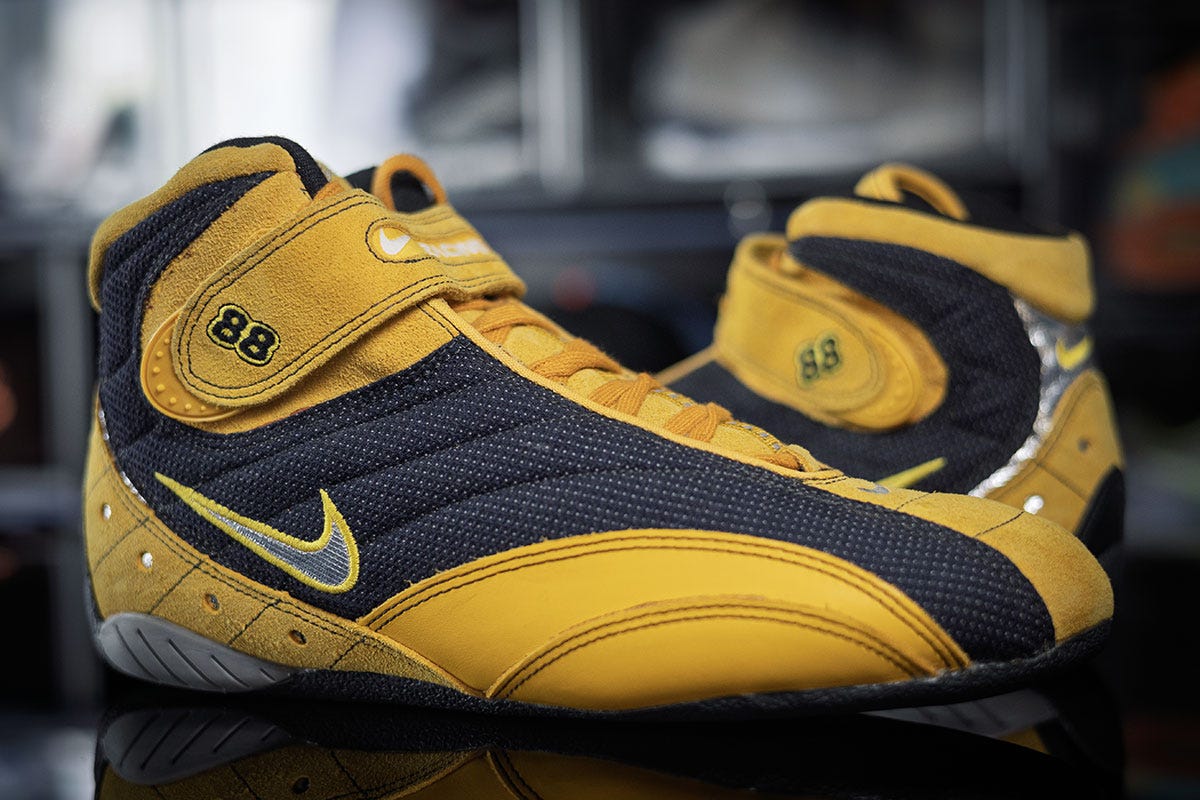
Jarrett drove the #88 for Robert Yates Racing from 1996 through 2006, with UPS coming on as primary sponsor in 2001. He won the 1999 Winston Cup Championship in that car. Nike’s color translation here is exact. They didn’t approximate the UPS gold, they matched it. “RACING” is embroidered on the Velcro strap alongside the Swoosh, and the construction is chunky and padded in that mid-2000s way, substantial enough to suggest this was built for comfort over long race weekends, not just for pedal feel inside a cockpit like other driving shoes.
Both the Labonte and Jarrett shoes represent Nike at a moment when they were genuinely committed to NASCAR as a sponsorship category. Driver by driver, team by team, commemorative shoe by commemorative shoe. It’s a strategy that mirrors what they were doing in F1 with Schumacher around the same period. Personal relationships, personal product, built around the identity of a single athlete rather than a team or series-wide deal.
The full scope of that commitment is worth pausing on. For the 2000 season, Nike had signed Jarrett, Labonte, and Stewart in the Cup Series, plus Adam Petty in the Busch Grand National Series, and CART and two-time Indy 500 champion Al Unser Jr. in open-wheel racing. That’s a cross-series roster built around some of the biggest names in American motorsport at that specific moment. Labonte was the reigning Winston Cup champion. Jarrett was the previous year’s champion. Stewart was one of the most exciting and combustible personalities in the sport, a former Indy Racing League champion who had crossed over to NASCAR and immediately become must-watch television. Adam Petty was NASCAR royalty (grandson of The King, Richard Petty) and one of the most promising young drivers in the series before his death in a crash in May 2000. Nike’s official press release at the time read: “Nike Racing focuses on the humans in and around the machine, helping them perform at the peak of their ability by providing quality footwear designed for their unique athletic requirements.” That language is important. Nike wasn’t branding cars or sponsoring teams. They were signing athletes. The same framework they used for basketball, football, and track. Racing was just another sport. The shoe was the proof.
Starter x Nike — Tony Stewart Player Exclusive (2007)
This one is different from everything else in this section, and it requires a little context.
