

Rick Maderis and I played phone tag for close to a year.
That isn’t a complaint. It’s what happens when two people are both building something on the side of something else. When we finally sat down for the Sneaker History podcast, it was worth every missed call.
If you don’t know Rick’s name, that’s part of the story. He spent more than twenty years inside adidas, Nike, Jordan Brand and Curry Brand, working on the graphics, color and storytelling that almost never get a name attached. Technical designer at adidas, then lead graphic designer for Originals. NIKEiD. Footwear graphics at Jordan. Three and a half years on Steph’s PEs and special projects at Curry Brand. And now he runs Burnside Knives out of Portland.
So the easy headline writes itself. Sneaker designer leaves sneakers, starts making knives.
That’s not exactly what happened.
About twenty minutes in, Rick told me about tilting the adidas trefoil fifteen degrees on a piece of apparel. It sold. People inside still told him he was messing with something he shouldn’t touch. His answer...
“Do you see what the guys are doing on the other side of the river?”
If you’re in the industry and been to Portland, you’ve heard that used in a lot of footwear offices.
The river is the Willamette. adidas North America on one side of Portland, Nike out west in Beaverton. It’s a funny line. It also tells you exactly how Rick works. He watches what’s around him, he pushes on the thing everyone else treats as fixed, and he does it with a grin.
He never left sneakers. He took everything sneakers taught him and pointed it at a different object.
And the more we talked, the clearer it got that the most valuable things the industry taught him were the parts it’s worst at crediting...
The Person Who Pulls The Rope
Near the end of our conversation, the talk drifted to opera. His partner sings, and he described himself as a spectator in that world, her number one fan. What struck him was how many people it takes to put on one show. “There’s a conductor, and there is a director, there’s an audio engineer, there’s a person who pulls the rope to open the curtains and sets the lights.”
Then he said, “But being a part of it is still something beautiful.”
If you’ve been in this industry for any length of time, you know that’s us. Most of the people reading this are not the name on the tongue. You’re the color designer. The graphic designer who separates the colors and builds the repeat. The developer who knows which factory can hit which material. The merchant who fought for the size run. You pull the rope.
Rick told a story about an apparel pack at adidas Originals where he listed off every title in the room. Apparel color designer, textile person, production artist, studio director, senior designer, product manager, merchandiser. And after all of that, the ask still landed on him... “Hey Rick, we need a pattern.” So he redrew it, separated the colors, turned it into a repeat and finished the tech pack.
Nobody outside that building will ever know his name was on that work. That’s normal. What I think this proves is that the industry has a whole class of people who learn to do five jobs at once, under pressure, for a logo that isn’t theirs. And we mostly treat them as interchangeable.
Rick described his own approach in a way I’ve heard from a lot of the best people I’ve worked with. “Being really good at a handful of things and not being an ace at one.”
That’s the toolkit. Color, graphics, story, and enough self-taught industrial design to be dangerous. It turns out that toolkit travels.
Sharpening Every Single Edge
We talked about retros, which carry a different kind of pressure than a brand new shoe. Everyone already knows what the shoe is supposed to look like. Rick had to redraw a grail Jordan pattern from scratch for an apparel tech pack, and he put the stakes plainly. “If you get something off, you’re gonna get roasted internally and externally.”
Then he said the line that ended up on the title card of the episode. “It’s not reinventing the wheel. It’s sharpening every single edge and adding a new finish.”
He said that about retros, more than half an hour before we got anywhere near knives. I don’t think he even noticed. That’s how deep the overlap runs.
Much like my conversation with Jason Mayden, and the job is to make people feel something.
What Gets Cut First
This was the part of the conversation I’ve thought about more than any other.
Rick talked about the focused collections, the heritage stories, Black History Month, Asian heritage, Nike’s N7 program, and he said out loud what a lot of people inside brands know. They “are the first to get cut when profits aren’t meeting.” Then he compared it to a shoe everybody in the room could picture. “You make billions of these shoes and they’re everywhere. And that’s printing money.”
I wrote about a version of this recently, how brands don’t put their best shoe where the money is. Rick came at it from the inside, from the person drawing the graphics on the small-run pair that gets cut when the quarter looks soft.
And he’s lived the other side of it. At Curry Brand he worked on projects honoring Lewis Latimer and Bruce Lee, and before he said yes to any of it, he asked whether he was the right person for the job. His words... “A good human being will ask those questions before they throw something on the table.”
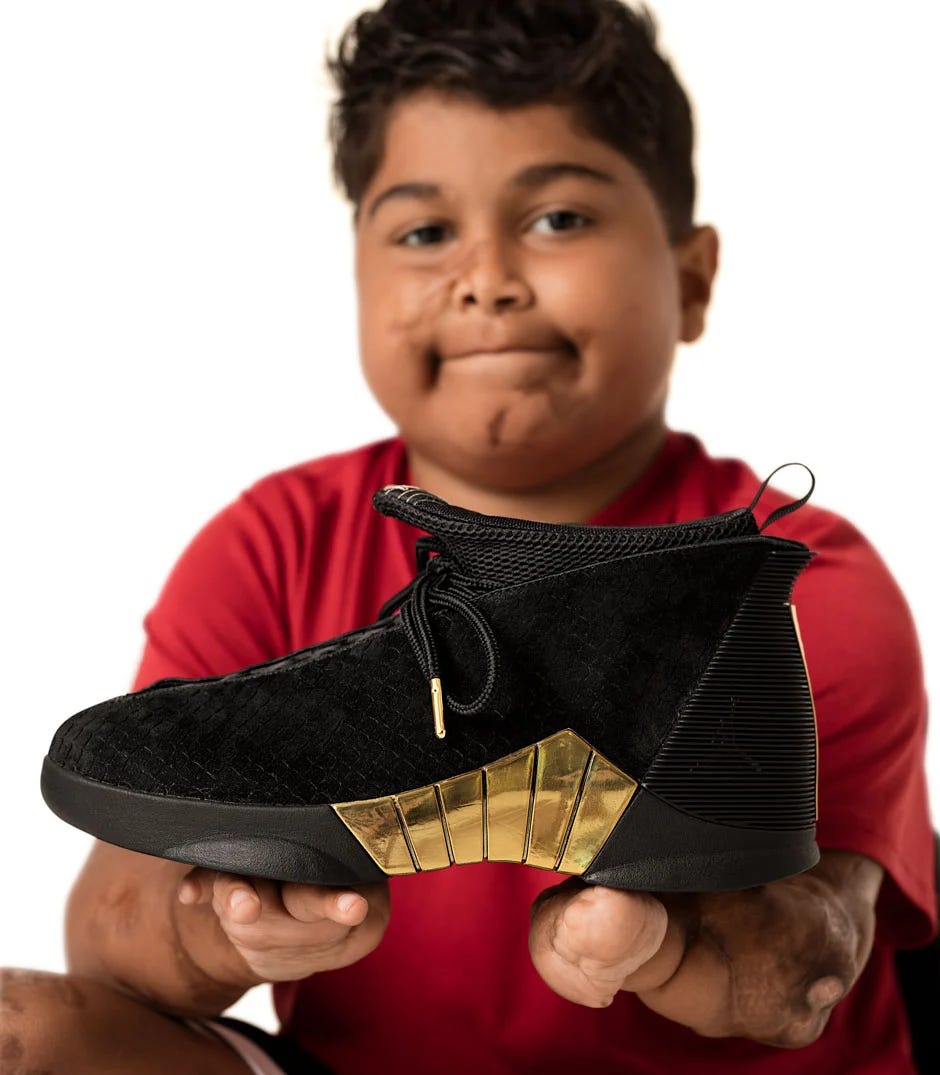
Before any of that, he gave his after-hours time to the 2018 Doernbecher Air Jordan 15, designed with a patient at OHSU Doernbecher Children’s Hospital. “This young little human is braver than most people I’ve ever met in my entire life.”
Nobody pays you extra for that kind of work. It’s the work people remember anyway.
Sneakers And Knives
So where did the knives come from?
Rick traces it to three things landing at once. Instagram was new, and hashtags like kicks of the day were how sneaker people found each other. He was noticing people posting their G-Shock next to their sneakers, putting fits together. And he realized Oregon isn’t only the home of Nike and adidas North America. It’s what he calls the biggest knife hub in the United States, with Leatherman, Gerber and Benchmade all in the state.
Then he went home for Christmas, didn’t know what to make his mom, and borrowed his dad’s metal shop. He grew up around a working cattle ranch, so a horseshoe was nothing unusual. He turned it into a wind chime. And while he was in the shop, the idea wouldn’t let go. “Sneakers and knives just kept running through my brain.”
At the time he’d moved from the east side of Portland to a tiny apartment on the west side, while still driving to adidas every day. His reasoning is so sneaker it hurts. If he lived on the west side, he’d run into Nike people at the grocery store and the coffee shop. “You gotta be around what you wanna be around, right?”
His drive to work crossed Burnside. That’s the name.
The first knives were hobby projects, pre-existing blades with handles he shaped himself out of barn wood and faux turquoise. He’d look at the color blocking and think, this will match an adidas shoe. “That’s weird, but it’s cool.”
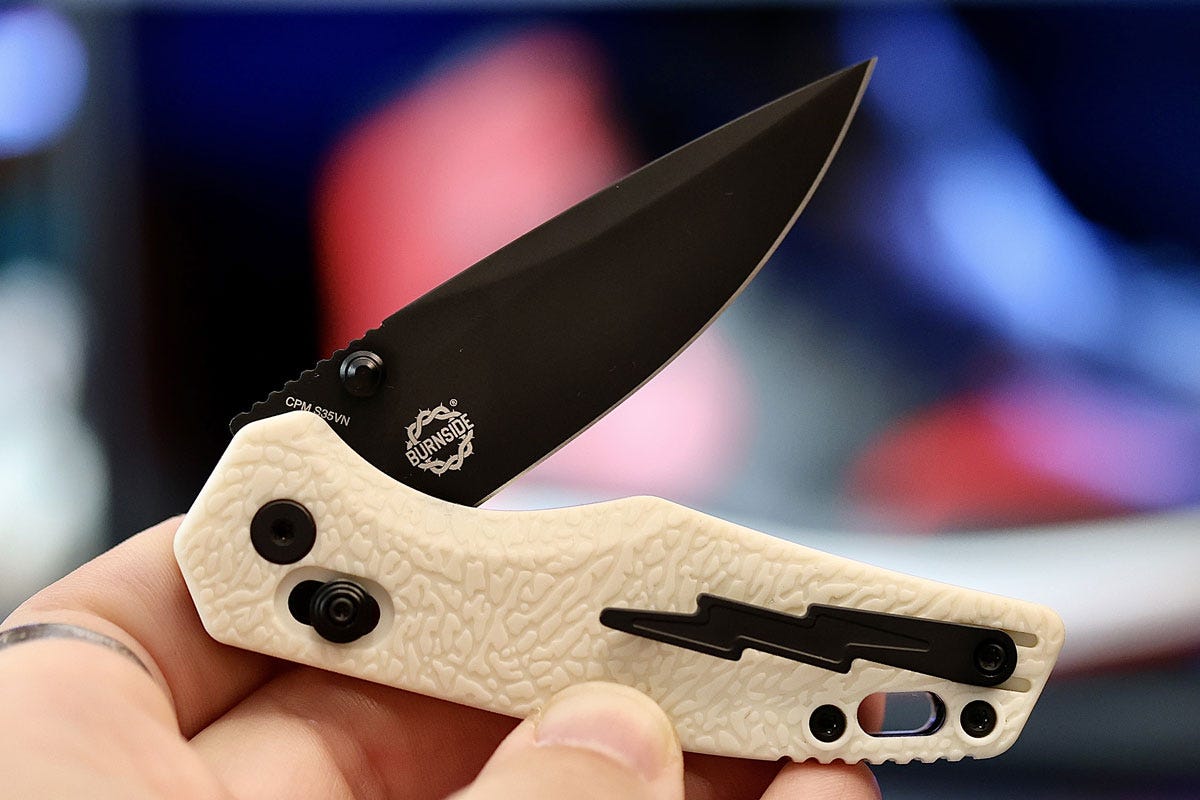
Today the details are all his. The handle texture I was calling elephant print is actually his own Magma Grip, inspired by the magma under Mount Hood. The Cabrillo 2, folded closed and held up from the middle of Lost Lake, traces the terrain and the peak of Mount Hood. He didn’t tell buyers until after it sold out. And when he went to the DMV, he asked if KNIVES was available as a license plate. It was.
Here’s how he explained the whole system. “The sneaker guy created this. It should look like it came from a sneaker guy.”
Take The Toolkit With You
Every time somebody leaves a big brand, the industry treats it like a loss column. Another designer gone, another reorg, another name we won’t see on a credits page. I get why.
Rick is the counterargument. The pressure, the fire drills, the five jobs at once, the tech packs nobody will ever see... that was the training. He even said as much about the chaos. “Some of the highlights in my books have been fire drills.”
So if you’re the person pulling the rope right now, the work you’re doing without credit is building something that belongs to you. It leaves with you. Rick took his to Portland’s knife country and built a brand where every detail has a story, which is exactly what he was doing for other people’s logos for twenty years.
And if you’re the one running the show, go find out who’s pulling your rope. Say their name in the room.
What stuck with me most was his honesty about where it’s all going. “I don’t exactly know what I want to be when I grow up still.” After twenty years inside the biggest brands in the world, with his own company and a license plate that says KNIVES, he’s still curious. That might be the most valuable thing this industry can teach anyone.
The full conversation is up now on the podcast and on YouTube. Go look at Rick’s work at rickmaderis.com, and if a piece at Burnside speaks to you, tell him. For full transparency, he sent me one of his knives for the episode.
Tell someone you like their kicks today. You never know how far a compliment will take you. And we all know how good it feels to be on the receiving end of some appreciation.
Keep building.
-Nick
I’m Nick Engvall. I’ve worked in the sneaker industry for over two decades. I built the original Eastbay Blog during my time at Sole Collector, led the first dedicated sneaker team for Complex, led the first UGC and seeding programs for Finish Line, employee #9 at StockX, Sr. Director at Stadium Goods, and much more. Now, I run Sneaker History and host the Sneaker History podcast, with over 600K downloads. Outside the newsletter, I take on select consulting and advisory work with brands, retailers, and founders across the footwear industry. If you’re building something and want an experienced set of eyes on it, reply to this one or reach out. I’d love to hear what you’re working on.
I couldn’t do this independent work without the readers who pay for it. If supporting independent thinking in the sneaker world is worth a few dollars a month to you...
Paid subscribers get the deeper proprietary analysis, the long retrospectives that tie sneaker history to where the market is heading next, and full access to over 200 stories in the archive.