

On a Wednesday in December 2000, kids skipped school and grown adults called out of work to buy a pair of basketball shoes from a movie that had come out four years earlier.
The Air Jordan 11 “Space Jam” had never been sold before. Michael Jordan wore the black and royal pair on screen in 1996, and Nike didn’t release it until the retro landed on December 13, 2000, at $125. The story, which has been told so many times it might as well be folklore, is that enough parents complained about kids cutting class that Nike started moving its big launches to Saturdays. Whether that’s the whole reason or not, the takeaway has held up for a quarter century. When Jordan Brand puts out an 11 in December, people change their plans.
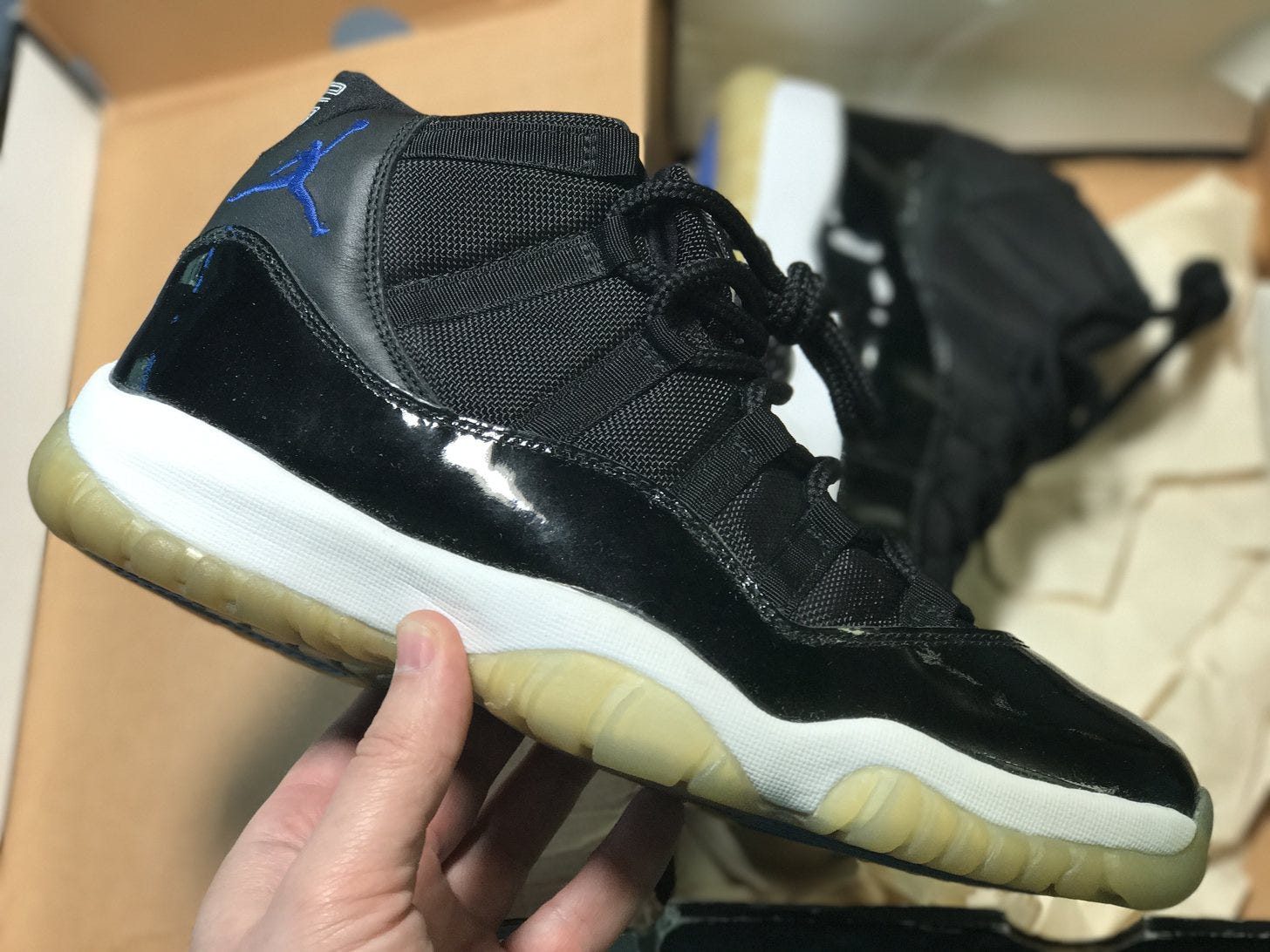
I’ve been thinking about that Wednesday a lot this week, because the Space Jam 11 is coming back again, this time for the film’s 30th anniversary. And I don’t think it’s an exaggeration to say this is the most important sneaker story on Nike’s calendar right now.
Not because it’ll sell out. It will. They all do in time, whether that takes ten minutes or ten weeks and a trip through the outlets. With the 11, the question has never been if it sells out. It’s how.
It matters more this time because of where Nike is right now, and because of what Nike’s own CEO said about Jordan retros ten days ago.
A quick note before I go any further. Jordan Brand’s media team set up a call for me with Terrance Harvey, Senior Manager for Jordan Retro Footwear, and Liv Bolung, Senior Manager of Streetwear Men’s Apparel Design at Global Jordan, to walk through the collection before it was announced. Nobody paid me, I didn’t get shoes, and nobody asked me to write this. A good part of what follows comes from that conversation, and I’ll tell you when it does.
The Shoe That Carries Christmas
You know how the holiday calendar has worked for most of the last two decades. There are a lot of releases. And then there’s the 11.
Tinker Hatfield designed the Air Jordan 11 for Michael’s return from baseball, and the original “Concord” released in 1995 during the season the Bulls went 72-10. Patent leather on a basketball shoe was a strange idea at the time. It turned into the most recognizable silhouette Jordan Brand has ever made, the one people wear with a suit, the one that shows up at proms and weddings and funerals.
The retros started in 2000 and 2001. By the late 2000s, the December 11 had become a near-annual tradition, and it turned into the release that every retailer planned their holiday around. Then the tradition got big enough to become a news story outside of sneakers. When the “Concord” came back in December 2011, shoppers were trampled and a mall door was ripped off its hinges in Indianapolis, and arrests were reported in at least a dozen cities. Retailers hadn’t asked for extra security because nobody expected it.
That’s the cultural side. The business side is even more telling.
When the “Space Jam” came back for its 20th anniversary in December 2016, Nike Brand president Trevor Edwards went on the earnings call that March and called it “the largest and most successful shoe launch in the history of Nike.” The pair it passed to take that title was the “72-10” 11 from the year before. Three years later, the “Bred” 11 from December 2019 was widely reported as Nike’s biggest release ever, and Nike’s COO said it sold out on SNKRS in 28 minutes.
Read those back. The 11 isn’t one release among many. It’s the shoe Nike has repeatedly pointed to on its own earnings calls when it wanted to show investors the brand was healthy. For most of the last decade, the December 11 has been the load-bearing wall of Nike’s holiday.
And for most of that decade, the way you measured an 11 was simple. How many pairs, and how fast did they go.
Hold onto that, because that’s the part that’s about to change.
Where Nike Is Right Now
I wrote about Nike’s first quarter last week, so I won’t rebuild the whole thing here. The short version is that it’s been a rough fall for Beaverton.
Revenue was $11.2 billion for the quarter, down 4%. Converse was down 28%. Greater China was down 26%. Nike told investors to expect full-year revenue to fall at a high-single-digit rate, rolled out a multiyear cost program it’s calling Pace, and said more roles will be cut along the way. The stock fell hard the next morning, and by the end of the week it was trading around $32, the lowest level in 12 years, down from roughly $175 at its 2021 peak. Nike’s market value and earnings have more than halved since Elliott Hill came back as CEO two years ago.
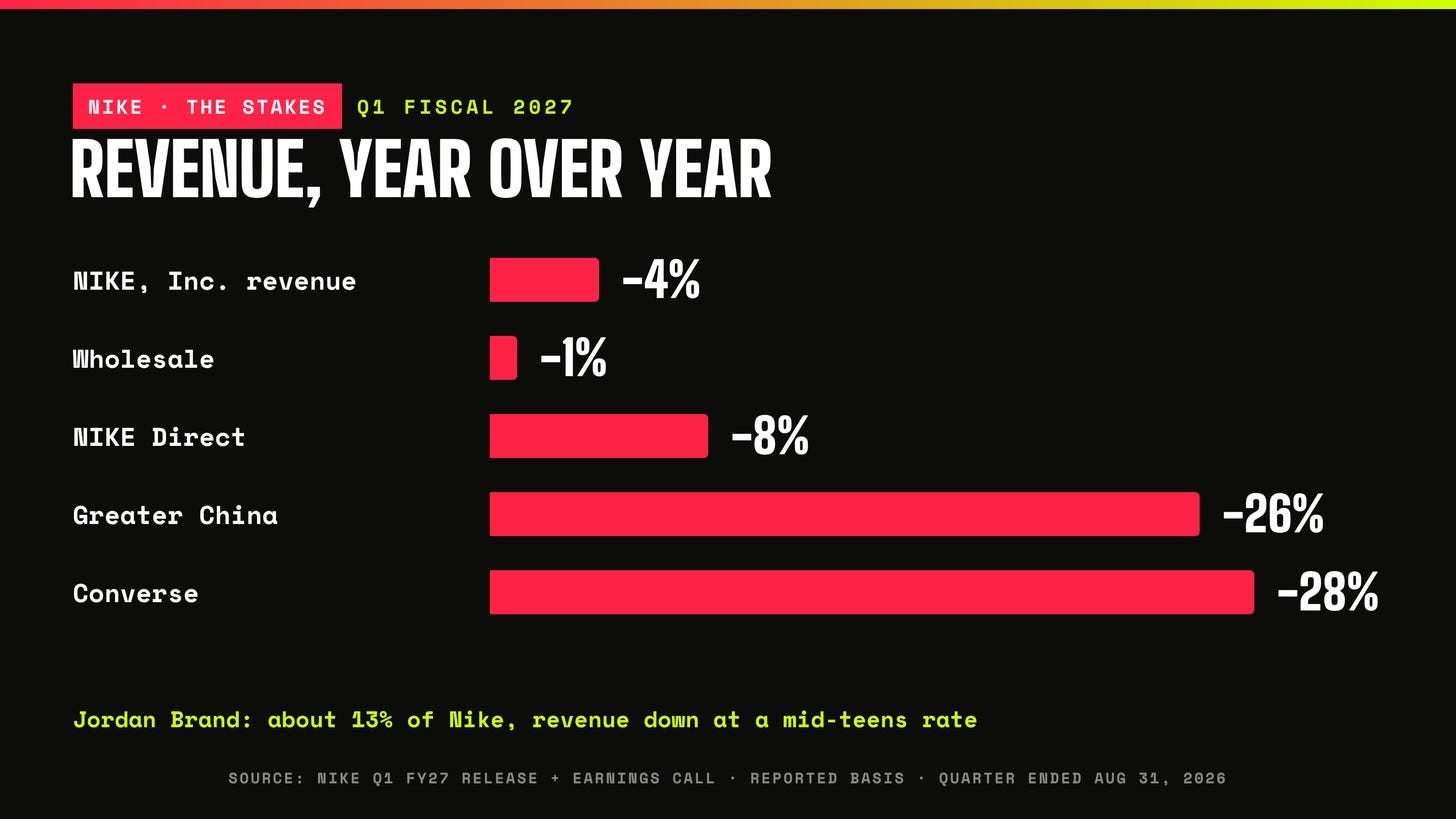
Jordan Brand is right in the middle of it. Jordan was about 13% of Nike’s business last quarter, and its revenue fell at a mid-teens rate. On the call, Hill named it alongside sportswear and China as the parts of the business holding everything else back.
Then he said the line that every person who has ever worked in sneaker retail has been waiting years to hear out loud.
“Simply put, we’ve been oversupplying our iconic retro product, asking them to do too much.”
Nike is cutting the volume and frequency of Jordan retro launches, especially in North America, with the full effect expected in 2027. Hill put the goal in one sentence. “When consumers see the Jumpman, it should feel special.”
You know what I mean when I say this isn’t the first time. Nike ran almost the same play nearly a decade ago, after overproduction left too many retros sitting on shelves. The difference is that in 2017 Nike was still growing. In 2026, it’s trying to stop shrinking, and it has an Investor Day on November 16 and 17 where it has to convince Wall Street the plan is working.
So here is the question that sits underneath this entire holiday.
What happens when the company admits it’s been oversupplying retros, and the biggest retro of the year is already on the calendar?
