The brief came from Michael Jordan, and it was one sentence long.
He wanted the shoe to look like it was in motion while standing still.
Leo Chang, senior creative director for basketball and sport at Jordan Brand, told me that’s what they were working against. Not fast in the way a spec sheet is fast. Fast to look at. Sleek, clean on foot, and visually moving while sitting still on a shelf. He tied it back to the way Jordan actually played, the end-to-end dominance, the stealthiness, the idea that by the time you saw him it was already too late.
That’s the kind of direction that sounds like a poster until you find out how it was enforced.
Donald Kelsey, DK, runs basketball and promo footwear. He described a feedback process with Jordan that’s more formal than I expected. Scheduled in-person checkpoints running from the initial debrief through final confirmation. His own size made up so he can put the shoe on and give fit feedback. And then, in between, the occasional phone call to pressure-test whatever the team had landed on.
The higher collar that was on the 41 early on did not survive it. Chang told me the opinions inside the building were polarizing, and that Jordan’s challenge was the deciding factor: no gimmicks. If it isn’t a hundred percent, take it off the shoe. Chang described the internal test as being ruthless about whether a sixteen-year-old was going to be annoyed trying to get the thing on. They couldn’t get to a hundred, so it went.
What survived is a shoe that hides most of what it’s doing.
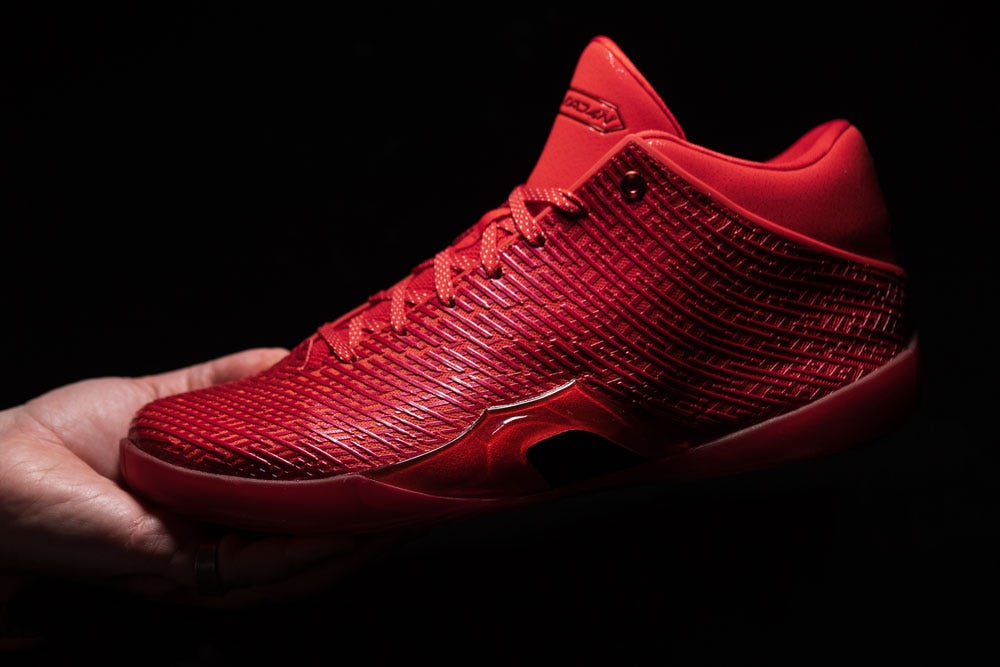
The upper is engineered mesh with a three-dimensional printed texture, moving away from the leather that used to define a game shoe, which drops weight and opens up what the graphic can do. Chang pointed out that the print catches and shifts light differently depending on the colorway, so the same upper reads as a different shoe across the line. The cushioning setup from the 40 carries over, the ZoomX and the full-length Zoom Strobel, with an additional Zoom bag added underneath in the heel. That heel bag came directly out of Jordan’s argument about defense, about staying on your toes and being as good on one end as the other.
There’s a carbon fiber and TPU shank that runs up onto the lateral sidewall so you can hit that wall on a hard cut and get snapped back the other direction. And on the bottom, a small window cut into the outsole where you can see the shank and a sliver of that heel bag.
Maybe it’s the car guy in me, but the window is the detail I keep coming back to. Chang told me it came out of visiting Jordan’s garage, where there are sixty-something cars, and where the supercars have glass in the rear deck so you can catch a hint of the engine underneath. He wanted the same on the bottom of a basketball shoe. Enough to know something is in there. Not enough to explain itself.


I should tell you where I’m coming from before I tell you what they found.
I own too many pairs of shoes with a red accent. I know exactly why. I grew up watching Michael Jordan. I’m a huge Iverson fan. I started wear-testing for Nike in 2001 and I’ve been buying, writing about, and hoarding basketball shoes ever since. That red shows up in my closet the way it shows up in the closet of anybody who came up in that era, which is to say constantly, and I have never once thought of it as a problem.
Jordan Brand spent six months this year finding out that it might be.
Kelsey walked me through the color research. The team spent the better part of half a year on the road running focus groups, hauling forty to fifty pairs into a room at a time. The US, Europe, and Asia. Academy and club teams in London, Paris, Amsterdam. More than 250 EYBL athletes, boys and girls, five-star and four-star. Product testing in China, Los Angeles, and Portland.
The method was simple. Put everything on the table, give no context, ask which three they’d take.
Athletes show you rather than tell you, he said. So the team wasn’t listening for answers so much as watching for a pattern.
The pattern they found was one nobody went looking for.
Not one kid asked where the heritage colors were. Not one asked about the retro palette. Not one asked about elephant print. Zero, in his words, male or female, at any level, on any continent.
I have watched the retro business become the load-bearing wall of this industry for twenty years. I’ve written about what happens when a brand tries to nostalgize its way out of a structural problem. I’ve watched performance basketball at Jordan Brand get quietly measured against a business that sells forty-year-old silhouettes at scale, and I always assumed the people inside the building saw that as a feature.
Kelsey used a different word for it.
The Word Was Cloud
He said the retro business had created “almost like a cloud over performance basketball,” and that things had gotten too blurry.
Sit with that, because a senior director at Jordan Brand describing his own company’s most profitable category as a cloud over his own category is not a slip. It’s a position. There’s a retro team whose job is to carry the heritage forward, and Kelsey’s draws a clear line. It’s their responsibility, not his team’s, and that the separation is the point.
This means that Jordan Brand is running two businesses that no longer share a customer, and maybe they’ve finally stopped pretending otherwise.
The retro customer is me. Forty-something, closet full of red accents, buying on memory. The performance customer is a sixteen-year-old in Amsterdam who has never seen Jordan play a live game and who judges a shoe by whether it disappears in the fourth quarter. Those two people have been sold to as one audience for most of my career, and the reason the game shoe kept getting graded against 1988 is that the brand kept inviting the comparison.
Chang framed the design side the same way without ever using the word. On the 40, they pulled iconic elements from the past and remixed them into something modern. On the 41, he said, they deliberately did not do that. What carried forward was the philosophy, the bold simplicity, not the parts.
Jason Mayden Didn't Take The Bait
Mayden was leading design while this shoe came up, and he’s the one person I talked to who has owned both sides of that business. When I put the color finding to him, he declined to call it a problem, and I think that’s the most interesting thing about his answer.
He didn’t tell me the heritage palette was a weight. He told me why it mattered in the first place. Red, black, and white were special because of what Jordan did wearing that jersey. They stand for something and they’ll never go away.
Then the turn. For this generation of Jordan consumer, he said, it’s important that they get their own moments. Their own colorways in context. Their own athletes doing things they didn’t think were humanly possible.
The game shoe, in his framing, is an intergenerational product. The parent, the uncle, the aunt, the siblings, the nieces and nephews all get their own moment with it, and color is the fastest way to have that conversation across those generations.


Then he said the part I keep thinking about. The brand may call something varsity red. The kid will call it something else entirely, and the brand won’t fight it. That name belongs to the kid.
“This consumer, this kid, is very invested in co-creation,” he told me. “They’re not interested in just being dictated to.”
Earlier in the same conversation he’d described what he set out to do coming back into the building after a decade away, and it turns out to be the sentence that ties all three interviews together. He said the biggest piece of the work was unpacking the difference between having reverence for the brand and simply referencing it.
“This is a reverential era, not a referential era.”
That’s Kelsey’s cloud and Chang’s philosophy-not-parts, said a third way by the person who was running design while they built it. I don’t think the three of them coordinated on it. Nobody arrives at the same conclusion in three different vocabularies by accident. That happens when a decision has been lived with.
Too Many Good Options On The Wall
There’s a competitive reality underneath all of this that nobody said out loud, and Chang came closest.
Talking about what separates a shoe that’s polarizing and great from one that’s polarizing and a gimmick, he said there are too many good options on the wall now for a kid to stay loyal to a gimmick.
That’s an important line. For most of my career, a Jordan number shoe competed against the last Jordan number shoe and against its own history. That was the field. A kid who wanted a signature basketball shoe had a short list and Jordan Brand sat at the top of it by default.
That’s over. Anta is building a real signature business. Under Armour has kept Curry Brand alive as a standalone. adidas and Puma have both rebuilt basketball from close to nothing, and I’ve written before about how quickly the performance basketball map has redrawn itself. Chinese brands are producing legitimately good hoop product at prices American brands can’t touch.
So when I hear that not one kid in that room asked for the heritage colors, I don’t hear an insult to the retro business. I hear that heritage no longer functions as a competitive advantage in performance basketball, because the kid choosing a shoe to actually hoop in has plenty of credible options and none of them are asking him to care about 1988.
That’s a much bigger problem than a colorway decision, and it’s the reason the color finding matters at all.
The Part Nobody's Going To Write About
Kelsey’s finding was explicitly male and female, boys and girls, at every level. Mayden went further than anyone when I asked about the women’s game, and it’s the most forward-looking material I got from any of the three.
More emphasis on women’s sport, he said, means more research dollars allocated to women’s sport. And you need that research to understand the biomechanics and the physiology of the woman athlete well enough to serve her at the highest level.
Then he made the case for why the women’s game is the better teacher. The footwork, the spatial manipulation, the off-ball defense, the mind games, the way the game breaks into improvisation. Most of it happens below the rim, which means you see the purity of it, the chess, the breaking down of an opponent.
He reached for boxing to explain it. He loves technical boxing, the kind most people would call a boring fight, two fighters at their prime who know how to preserve energy and shoulder roll and evade. The average viewer wants a brawl. If you love the sport, you study the technician.
I told him I’d say the same thing about baseball, that I’d take a pitcher’s duel over a slugfest every time, and he was right that it’s the same instinct.
What that translates into on the design side is specific. Foot morphology. Weight. Traction placement. Toe splay. Responsiveness. How much pressure a player actually generates, and therefore how much force it takes to activate the cushioning in the shoe. His words: it radically shifts how we design.
He pointed at the Jordan Triangle as an example, a shoe built around her needs that men can play in too, and said the 41 accounted for multiple styles of play across the W and the NBA both.
He also reminded me that this isn’t new for the brand, bringing up April Holmes, the Paralympic sprinter Jordan Brand highlighted years ago, and whose carbon-fiber blade work fed into the Air Jordan 2009 that Mayden designed himself.
This illustrates where the actual innovation pressure is heading. The heel Zoom bag on the 41 came from Michael Jordan’s argument about defense. The next real change to a basketball shoe is more likely to come from research into how women play than from anything else on the table right now, and Jordan Brand knows it.
Who's Building It Now
One detail from the Mayden conversation reframes this whole release for me.
He told me the essence of the XX3 was an obsession with craft in service of performance, and that he was there for it, working alongside Mark Smith, Tinker Hatfield, and Tom Foxen on material science and construction methods, back when the fight was over water-based and solvent-free glues.
Going into the 41, he said, the same conversations were happening. Look at the paneling, the outrigger, the facets, the collar height. Same conditions. Different players on the court.
Chang at the helm. Kelsey on footwear. Peter Koytroulis now in the chief design officer seat, after Mayden moved in May into a newly created role leading Jordan Brand’s LA28 work.
That’s a group without the long collective history of building a game shoe together, which is either the risk or the entire point depending on how the 41 lands. Mayden said that it was fun to watch them come into their own and bring their own emotional connections to the product.
It’s worth knowing what he’s measuring them against. Mayden walked into Jordan Brand as its first design intern in 2001. He designed the Air Jordan 2009, the flagship, off a fencing idea he and Jordan agreed on. He designed the Jordan CP3.II around the footwork of futsal. He left in 2014, built a company, and came back a decade later to run the whole design org.
Ask him what makes a game shoe beautiful and he doesn’t answer with technology. He told me the brand is a brand of shape, proportion, light, and shadow, and then described being a kid the night before school, lying in bed turning the shoe over in his mind’s eye, following how the lines flow around it. A primary read, a secondary read, a tertiary read, every single time.
That’s a designer describing the exact experience he later became responsible for manufacturing. The kid in the bedroom became the guy who put a window in the outsole so somebody else’s kid would pick it up and turn it toward the light.
What Actually Gets Judged
Every Air Jordan number model gets sentenced by the internet in about three hours, by an audience that hasn’t held the shoe, won’t play in the shoe, and in a lot of cases doesn’t hoop.
Chang’s position is that polarizing has always been the deal. Some of the best ones needed time to turn from hate into love, and if you don’t get that reaction you probably played it too safe. He also drew the line that matters. Polarizing plus performing is how a game shoe becomes great. Polarizing for its own sake is a gimmick. He mentioned almost in passing that his college professors were harsher critics than anyone on the internet has ever been.
Kelsey was blunter. He said they’re not there for moral victories, and then listed what he’s waiting on before he’ll call it. Global adoption. Reception. How it performs. What the testing feedback says. Whether a player has a defining moment in it. That’s a scorecard measured in seasons being run against a verdict measured in hours.
Mayden’s version came from someone who’s been designing under that verdict since he was an intern. He told me he’d rather have an adverse reaction than no reaction, that indifference is the thing that would bother him, and that a game shoe is never supposed to be lukewarm.
He also gave me the best description of the process I’ve heard from anyone in the building. Things change on this product so fast that if you get attached to something for forty-eight hours, you’ll find out it doesn’t work, or the consumer isn’t going there, or somebody found a better way.
“You never really finish an Air Jordan,” he said. “You just run out of time.”
Where I Land
Aesthetically, I’m in. The look and the feel of it speak to me, and I say that as someone whose closet argues the opposite way.
After talking to these three about the process, the team behind it, and the research they did with the younger generation and with actual hoopers, I’m more optimistic about how the sneaker community looks back at this shoe in three, six, or twelve months than I was when I first saw it.
If you made it this far, I’d like to know where you stand on the Air Jordan 41 right now. Reply to this email or drop a comment. Then check back in with me in a few months, because Mayden’s point about a signature Air Jordan never being finished cuts both ways. As consumers, the game shoe isn’t done at first look or first review either. The 41 will grow on some of you and away from others. As long as it makes you feel something, it’s done its job.
Keep building.
-Nick
I’m Nick Engvall. I’ve worked in the sneaker industry for over two decades. I built the original Eastbay Blog during my time at Sole Collector, led the first dedicated sneaker team for Complex, led the first UGC and seeding programs for Finish Line, employee #9 at StockX, and much more. Now, I run Sneaker History and host the Sneaker History podcast, with over 600K downloads. Outside the newsletter, I take on select consulting and advisory work with brands, retailers, and founders across the footwear industry. If you’re building something and want an experienced set of eyes on it, reply to this one or reach out. I’d love to hear what you’re working on.
I couldn’t do this independent work without the readers who pay for it. If supporting independent thinking in the sneaker world is worth a few dollars a month to you...
Paid subscribers get the deeper proprietary analysis, the long retrospectives that tie sneaker history to where the market is heading next, and full access to the archive.
Watch the full Jason Mayden interview below:


I love the color & laces